When downsizing your car, you should consider factors such as lifestyle needs & changes, better cost control, environmental concerns, and easier management. People evolve, and priorities change, especially now when the cost of living weighs heavily on many of us. Downsizing could be the key to necessary changes and savings.
The average monthly car payment takes up a notable portion of a consumer’s income, and this proportion has been rising over time, making vehicle affordability an important factor for many buyers. This change reflects the financial strain many Namibians are under, putting a spotlight on affordability as a key reason for downsizing.
We know that the downsizing route is a big change that can stir up a lot of emotions, especially when you’ve become comfortable with your bigger car. In this blog, we’ll discuss the reasons surrounding downsizing, why it could be the right step for you, and how Cartrack can keep your compact car protected.
What are some reasons to downsize your car?
Some reasons to downsize your car include looking to save on costs, going greener, lifestyle changes, and better car management. We also understand that, given the current state of the economy, saving money is usually the main reason why these sorts of lifestyle changes happen. Downsizing could be an impactful and positive first step for you and your family.
Smaller cars provide long-term savings
Fuel and maintenance are the highest car expenses. Your choice to downgrade your car means better long-term savings because smaller cars typically use less fuel and have simpler car parts. When going the smaller car route, consider getting a car that’s lightweight and city-ready to accommodate your daily trips.
You could also consider getting a hybrid or EV (electric vehicle), which can save you so much money in the long run. Fuel wouldn’t be as much of a concern (if at all!), and EVs generally have fewer moving parts, meaning you cut back on having to service your car too often.
Your daily routine and lifestyle are changing
After costs and expenses, one of the biggest factors that drives downsizing is lifestyle changes. Maybe the kids have finally flown the nest, and there’s no need for a big family car anymore. Or perhaps your hobbies have changed and you don’t need a car that can hold all that camping gear. Whatever your reason, it’s valid.
If you don’t really need that bigger car anymore, downsizing could make an exciting difference in how you enjoy life from here on out. You get to save while also comfortably adapting to the new changes in your life.
It’s better for the environment
Using a car with a smaller engine means better fuel efficiency, which means fewer carbon emissions, which means a car that’s better for the environment. Bigger cars usually emit far more carbon and air pollution than smaller models, creating more harm to the environment.
Bigger cars, especially if they’re luxury brands, also tend to have more expensive and even special/customised car parts. These parts might need unique and expensive materials for them to be made.
Smaller cars are easier to manage
When you drive smaller cars, being on the city roads is a breeze. You fit comfortably into awkward parking spots (no need for 15-point turns). You can move through traffic smoothly, bobbing in and out with confidence, and the notoriously narrow streets will no longer be a problem.
Overall, smaller cars are easy to manoeuvre. Bigger cars need more space to carry out basic moves, like lane changes and U-turns, while smaller cars manage these with ease.
How can Cartrack add safety features to your smaller car?
Cartrack can add safety features to your smaller car by giving you the best in tracking and on-road protection. You can choose what your tracking package looks like and what services speak to your needs. Even at our most basic (Quick) solution, you’re guaranteed mobile app access, world-class live tracking technology, quick emergency response, and stolen vehicle recovery (SVR).
Our personal packages offer highly competitive monthly rates, emphasizing affordability and keeping your costs low. Our contracts are also flexible, so you can choose the structure of your payment plan. If at any point you’re considering a package change, you can easily do so at a small migration fee.
Your decision to downsize may’ve been a bit stressful, but choosing the right vehicle protection partner doesn’t have to be!
Final takeaway: downsizing to make life manageable
There are many reasons why you might decide to downsize your car, and this blog is a great insight into all those potential motives. We recognise that you’ve decided to adapt to your new way of life and sit comfortably with this change.
On the journey of trying to find a car that works for your new lifestyle, you can relax knowing that downsizing has so many perks. You, your wallet, and the environment benefit from the change; so everyone wins! What’s more? Cartrack can add to your happiness, keeping your smaller car closely watched and protected.
The 20/3/8 rule suggests that when you’re looking to buy a car but still want to stay in control of your finances. The rule says:
you should put down a 20% payment
you should pay off the car in 3 years/36 months (or less)
keep your car’s monthly costs under 8% of your monthly income
Are SUVs expensive to maintain in Namibia?
Yes, SUVs can be expensive to maintain in Namibia, especially because of their overall costs. From fuel and maintenance to more expensive car parts and insurance, SUVs are likely to put more of a dent in your pocket. This is especially the case for luxury brands with specialised internal parts.
Is GPS tracking worth having if my car is insured?
Yes, GPS tracking is worth having if your car is insured.
Your GPS tracker tells insurers that you’re taking extra care of your car, and safety is a priority. Insurers see this as a positive, and you could potentially get a lower premium out of this. It could also speed up claims processes in the future.
Security guards are high-risk workers that rely on road safety measures and clear communication to do their jobs optimally and stay safe. We need these people, and we need to find better ways to keep them safe (since that’s what they do for us). This is especially true during times when they’re responding to security alerts.
Road traffic collisions remain a significant concern in Namibia, and emergency responders face challenging conditions when attending to serious accidents, suggesting that the risk of stress and trauma is present even if local research has not quantified it. This is higher than the number of fatalities suffered by the general population. The reason? Fast-moving traffic and secondary incidents that happen DURING the response.
At Cartrack, we’ve thought about these realities while developing our fleet management software. We’ve also talked to fleet managers who deal with real-life problems in this high-risk industry every day. If you manage a fleet of security guards or operate in this line of work yourself, this article will guide you on how to keep security guards safer and more efficient on the road.
How can high-risk staff be kept safe on the roads?
The best way to keep high-risk staff safe on the roads is through a system that:
Prevents accidents
Shows evidence of what happened during an incident
Provides full visibility into cabins & roads
Provides full real-time remote guidance and training while responders are on the road
Defining high-risk industries in Namibia
High risk industries in Namibia are typically those that employ security staff to be first responders to incidents like trespassing, criminal activity, or break-ins. They include the hard-working security guards that patrol our neighbourhoods—that we pass by every day, often without a second glance.
It’s helpful to take a closer look at how the security guard industry faces challenges and how those challenges can be met through technology like fleet management software. When we’re talking about “protecting” high-risk staff on the roads of Namibia, we must find ways to keep them safe by understanding the dangers they face on a day-to-day basis.
What are some of the dangers high-risk staff face on the roads?
Some of the dangers faced by high-risk staff on our roads include having to rush to a scene on less-than-optimal roads, and having to deal with other road users while doing so. Other challenges can be loadshedding, bad weather, and heavy traffic on busy roads. These situations can make it dangerous for high-risk staff to do their jobs.
Cartrack has tried to look at the security patrol industry from an angle of safety. Subsequently, we’ve come up with various solutions that keep high-risk staff safe. But first, we must understand the INDIVIDUAL challenges this industry faces.
Security guard response times
Security guards that drive around your neighbourhood are under a lot of pressure to respond quickly when signalled to do so. But this isn’t always easy. Damaged roads, heavy traffic, and bad weather can take minutes off a response time, resulting in a late arrival.
Example: A security guard patrols the roads of a small town in Windhoek, Namibia. He knows the roads well, and knows exactly which road to take when he receives a call that a possible robbery is taking place. He rushes to the scene, but hits a massive pothole on his way there. His tyre is flat and he’s stranded, not able to assist in the incident he was closest to.
Visual evidence of incidents
What about when the security patrol reaches its destination? Knowing what transpired during that incident is of utmost value if certain claims are made after the fact. Security guards are dealing with dubious characters that might lie to get out of trouble, and place false blame on the guard to take attention off themselves.
Hard-working security personnel will have more evidence of what transpired at an incident scene with vehicle cameras that provide a POV (point of view) of their arrival, and possibly their subsequent actions.
Example: A security guard is called to investigate vagrants on private property. When he gets there, he finds them selling an illegal substance to passer-by. When confronted, the vagrants claim that the illegal substance was planted on them by the security guard in order to frame them. But vehicle camera evidence proves their claim to be a false one.
Optimal vehicle health
When patrols are called to investigate a security breach, speed is of the essence. To achieve a good response time, they need to have their vehicles in optimal condition. This is another form of protection for your high-risk staff, because they drive around a lot, and often need to dash from one place to the next in a hurry.
What your security fleet needs is a rotation of healthy vehicles that can always be counted on to get your guards to their destination safely. A good FMS will always schedule vehicle maintenance according to individual vehicle conditions—as opposed to a flat schedule.
How? Vehicle diagnostic hardware, coupled with predictive AI maintenance scheduling, gives you a big picture view of your fleet’s health. Now your vehicles are not only on the road more regularly, but they can also be relied upon by your guards for timely responses.
Sounds like a lot of challenges. Can one solution solve them all? Contact Cartrack today and find out how far technology has come to keep your high-risk staff safer and more efficient on the roads.
How does FMS solve high-risk road challenges for security guards?
Fleet management software solves the challenges of high-risk staff by providing them and their dispatchers with more comprehensive visibility, route optimisation, and communication. Using camera technology, AI-powered software and GPS, high-risk industries can optimise their operations and become safer and more efficient at work.
The goal at Cartrack is simple:
We want to prevent accidents
We want to give you a full view of what your security guards face each day and night
We want your drivers and first-responders to be more efficient in their services
With that in mind, let’s look at how FMS allows you to do these things.
Full visibility
FMS uses camera technology to record pertinent footage of road events, as well as in-cabin events (if that option is chosen). This gives you as the high-risk staff fleet manager a majority of the information you need to:
Accurately deal with insurance claims
Hold your drivers accountable for their driving habits
Record on-site incidents for a fuller picture
Security fleet managers know how often insurance claims are made in this industry. They also know how important it is to maintain a reasonable “duty of care” so that premiums don’t shoot through the roof.
GPS tracking and route optimisation
Combined with vehicle cameras is GPS tracking. These two work well together to help guide & direct your high-risk staff while they’re on the roads. GPS tracking, coupled with AI, also helps you plan out the best possible route at any given time, taking into account the current traffic, road conditions, road blocks, etc.
As we’ve already seen, timing is of utmost importance when it comes to first-responders. If your team is spread out across a city or suburb, GPS helps you assign the closest available person to the scene, allowing them to get there faster.
Driver coaching
Further to the first point (driver visibility), driver coaching is also possible with new AI camera technology. This isn’t just about recording a bad driving event and dealing with it later. Today you can allow your cameras to do this in real-time, alerting you and your drivers to risky or potentially dangerous actions that need to be corrected IMMEDIATELY.
Driver coaching also allows you as a fleet manager to REWARD those drivers who consistently show good driving. Let’s be frank: when it comes to security patrols, some emergencies might call for riskier driving to get to the scene quicker. But an FMS system can help distinguish between when driving should be calm versus when it calls for speed and risky manoeuvring.
Incident alerts
First responder emergency staff are at a higher risk of being involved in an incident themselves while responding to another. When this happens, it needs to be attended to fast.
Collision alerts form part of modern-day fleet management software. This helps you keep your high-risk staff safer by knowing exactly when a collision has taken place, where they are, and who’s the closest person to offer assistance.
Promote a better safety culture within your organisation
Keep your security personnel effective in their duties
Where does Cartrack fill the gaps for high-risk industries?
Cartrack fills the gaps for high-risk industries by offering real solutions to everyday challenges faced by security guards. By expanding visibility for fleet managers, monitoring driving & location, and having a record of what happened at every incident, high-risk staff are kept safer on SA’s roads.
What FMS solution should I choose?
Good question! The great thing about Cartrack is that we don’t believe in a one-size-fits-all approach to FMS. Instead, we listen to what you face each day and tailor our product offering according to what solutions would benefit you the most.
Why is this good for you?
You never pay for tools or features you don’t need
Your tools are perfect for the job at hand
You can integrate existing tools with ours
What if our FMS needs change in the future?
If your fleet management needs change in the future, Cartrack’s solutions are designed to adapt. Whether your operations become larger or smaller, we’ll be there to scale your FMS according to your needs.
What if I already have FMS tools and just want them upgraded?
Perfect! Cartrack’s FMS is designed to integrate into your existing platform. Why get a whole package when you only need a few extra features? We can help you with that—just give us a call!
Protect your high-risk staff today. They deserve your protection. And us as Namibians need these modern-day heroes to protect us. So give them the best fleet management Namibia has to offer. Give them Cartrack.
Frequently asked questions about how to protect your high-risk staff
How can I train my drivers to be safer on the road?
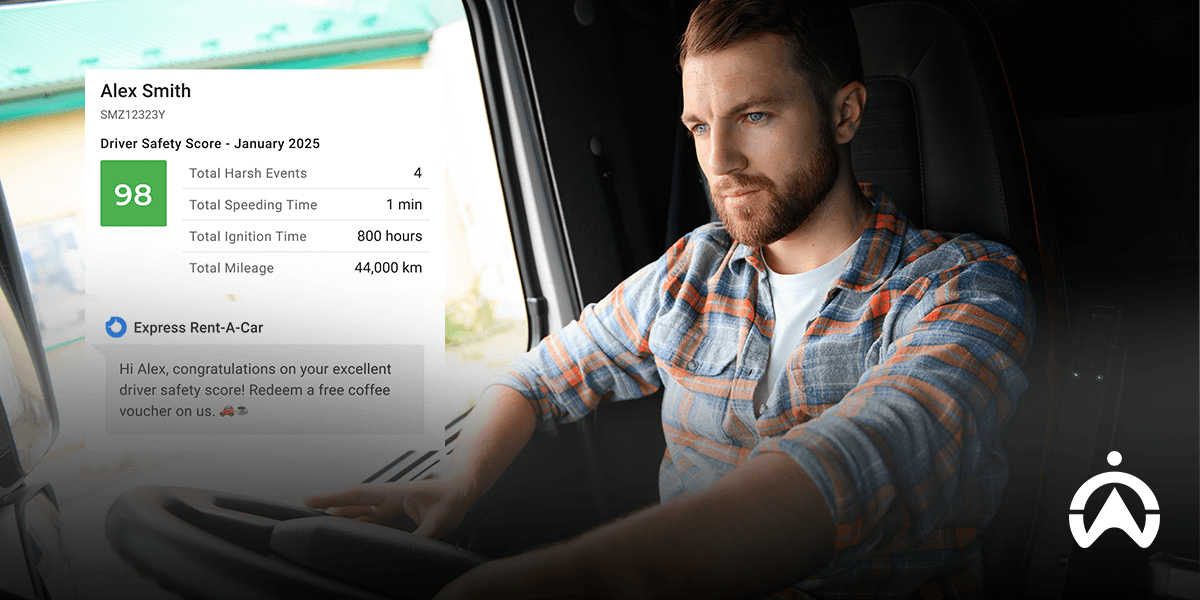
The best way to train your drivers to be safer on the road is through Cartrack’s driver scorecard system. It monitors and corrects driving, but also gives you a big picture perspective of who’s driving well, and who isn’t. From there you can easily address individual issues and fill the gaps for drivers who need guidance in certain areas.
Can dashcam footage be used in court to exonerate my drivers?
Yes, in Namibia dashcam footage is admissible in court and can be used to exonerate your drivers if they weren’t at fault. For fleet companies, dashcams have become an absolute must-have, as they can save you thousands in insurance disputes and legal cases.
Is AI technology being used to keep people safer on the roads?
Yes, in many ways AI is being integrated into FMS to improve it and keep people safer on the roads. A main way this is done is through AI cameras that detect smoking, eating or drinking, distraction, fatigue, and even seatbelt use.
If you have a vehicle, big or small, you should get an insurance-approved vehicle tracker today—because in Namibia, it’s a necessity, not an option. Drivers and fleet owners not only have to worry about hijackings but also the financial strain that comes with having your vehicle stolen.
Vehicle hijacking remains a concern in Namibia. While exact numbers vary, incidents occur regularly across the country, highlighting the importance of vigilance and road safety for all drivers.
So what does this mean for Namibians? It means that on top of worrying about dropping your kids off at school, avoiding traffic, dodging potholes and getting your stock to your clients; you now also need to worry that every time you’re on the road, if you’re going to be a statistic.
At Cartrack, we unfortunately can’t remove the thieves from the road, but we can make their “jobs” harder, your lives safer, and possibly your insurance premiums lower—all thanks to our top-of-the-range vehicle tracking device.
Why do insurance companies insist on certain brands of trackers?
Insurance companies insist on certain brands of trackersbecause only certain trackers have been certified by recognised independent organisations in Namibia. This certification backs the quality and reliability of the device, meaning that the chance of your vehicle being retrieved after being stolen is much higher.
The aspects that recognised independent organisations check on a tracking device include:
Battery life
Durability
The device’s communication capability during an emergency
It’s the same reason you’re more likely to choose an established phone brand when buying a new phone. You trust that the brand made a quality phone that won’t break after a small fall. Your vehicle is a much more valuable asset compared to your phone, which is why you should want to protect it with the right, reliable tech.
A bonus to you for getting an insurance-approved tracker means that you’ll possibly be able to lower your insurance premiums!
How an insurance-approved tracker saves your pocket
An insurance-approved tracker saves your pocket by removing the financial burden that comes with having your car stolen. A high-quality tracking drive (like the one from Cartrack) will increase the chance of you getting your vehicle back and just having one fitted will likely lower your insurance premiums.
Protecting your asset
An insurance company is there to help you out when something happens to one of your assets. A tracking device helps keep one of your biggest assets safe, assuring you and your insurance that if your vehicle does get stolen, the chance of you getting it back is high.
Think about the costs that come with having your car stolen. You now need to figure out how to get around, and using an e-hailing company or renting a vehicle is expensive. And even with insurance, the payout usually doesn’t cover the full cost of a new vehicle, which is why it’s always better to have your vehicle recovered than to rely on the settlement.
One of the reasons insurance companies love Cartrack is because we have numbers to back our claims.
Protect the person, not just the car
Tracking devices help protect the person, not just the car. This is because modern tracking devices do more than just track a GPS location. Tracking devices, like the one from Cartrack, have features like panic buttons, roadside assistance and automatic crash detection.
All of these features put you at ease when you’re on the road and reduce your risk valuation from your insurance company. So if you look at it like that, it’s really a win-win situation.
Trackers can turn compliance into a competitive advantage
An insurance-approved tracking device will help you turn compliance into a competitive advantage because you’ll have secure and reliable eyes watching your fleet when you can’t. Advanced tracking devices also give you operational insightsthat you’ll be able to turn into valuable insights.
Reduce your fleet’s total risk cost
Businesses with fleets often have the highest insurance rates on their vehicles. This comes down to the fact that you’re a higher-risk client compared to the everyday person. Your fleet travels on busy roads constantly, they carry expensive cargo, and trucks and delivery vehicles are more expensive in general.
It also makes business sense to try and reduce the total risk cost associated with your fleet. When you install insurance-approved trackers in your fleet, you have the ability to negotiate with your insurance provider to get lower rates.
Rapid recovery keeps your business moving
Let’s say one of your heavy-duty trucks carrying half a million rand in materials has been stolen. Dealing with the insurance to get the payout isn’t even half of the battle you’ll have to fight. What about the client waiting for their stock and your driver that has been traumatised?
Invest in a tracking device from Cartrack that has rapid recovery teams, and who’ll work around the clock to get your truck back before the cargo has been stolen or damaged. Invest directly into the success of your business!
Improve your driver’s behaviour
An insurance-approved tracker has the ability to provide you with accurate data on your drivers’ driving behaviour. This tech allows you, as the fleet manager, to monitor how your drivers are performing on the road.
You’ll know if they’re:
Speeding
Breaking/cornering harshly
Idling excessively
Stopping at unplanned destinations
Taking unauthorised detours
Having the data available gives you a leg to stand on with your insurance company because you can prove to your insurance provider that you have reliable and responsible drivers.
The tech behind a certified tracker
The tech behind certified trackers is multi-constellation GNSS and GSM tech. This technology is what ensures accurate location tracking and prevents signal jamming. One of the main reasons insurance companies prefer certain vehicle trackers is because only certain devices have advanced tech that can truly support vehicle recovery.
What are multi-constellation GNSS and GSM?
GNSS and GSM are advanced tracking units that are designed for finding your vehicle even in the most remote/low-signal areas. Basic tracking devices solely rely on GPS tech, but advanced units, (like the ones from Cartrack) use multi-constellation GNSS, which connect to multiple satellite systems.
This is why we have such a high recovery rate, and why insurance companies love us!
Jamming detection and alerts
Criminals have gotten smarter, and instead of them just taking your car and hoping for the best, they’re using signal jammers to block the signal of your tracking device. At Cartrack we like to be one step ahead. Our tracking units are designed to detect when our signal is being blocked, and when this happens the unit will trigger an internal alarm and send an alert to our control room.
This type of tech gives us the insurance stamp of approval!
Durability and backup battery
A tracker can’t be useful if it can be disabled when the car battery wires are cut. An insurance-approved tracker, like ours, has a backup power source. This way the signal will still be transmitted even without the vehicle’s main source of power. Cartrack’s tracking devices are also designed to handle extreme temps and vibrations.
Giving you the reassurance that you’ll always be protected no matter the circumstances.
Cartrack: The gold standard for insurance-approved trackers
Cartrack is the gold standard for insurance-approved trackers because we can back up our claims with numbers. Over the past 10 years we’ve recovered around 100 000 vehicles, and every day we’re recovering more! We also have a lifetime maintenance warranty on our hardware, making sure you’ll always be protected.
And if you’re still unsure as to why you should choose us to be your insurance-approved tracker, remember that there are a lot of companies that can show you where your car is on a map…but there are only a few that can go out and get it for you. And Cartrack is at the top of that list.
Does Cartrack share my private driving data with my insurance company?
No, Cartrack won’t share any of your private data with your insurance company, unless you ask us to! We’ll provide you with a certification to prove that we installed our device for you, but unless you’ve requested it for a claim, your data will stay with us and you!
Can the tracking device interfere with my car’s electronics or battery?
No, if you have a proper tracking device, it won’t interfere with your car’s electronics or battery. At Cartrack our units are non-invasive and are only installed by our certified technicians, so you won’t have to worry about it messing with your battery or ECU.
Will the tracker still work if I drive across the border into a neighbouring country?
Yes, a Cartrack tracking device will still work if you drive across the border into a neighbouring country. Our network has a strong connection across Africa, and they work even in the most remote areas with weak coverage, so you’ll be protected on every journey!
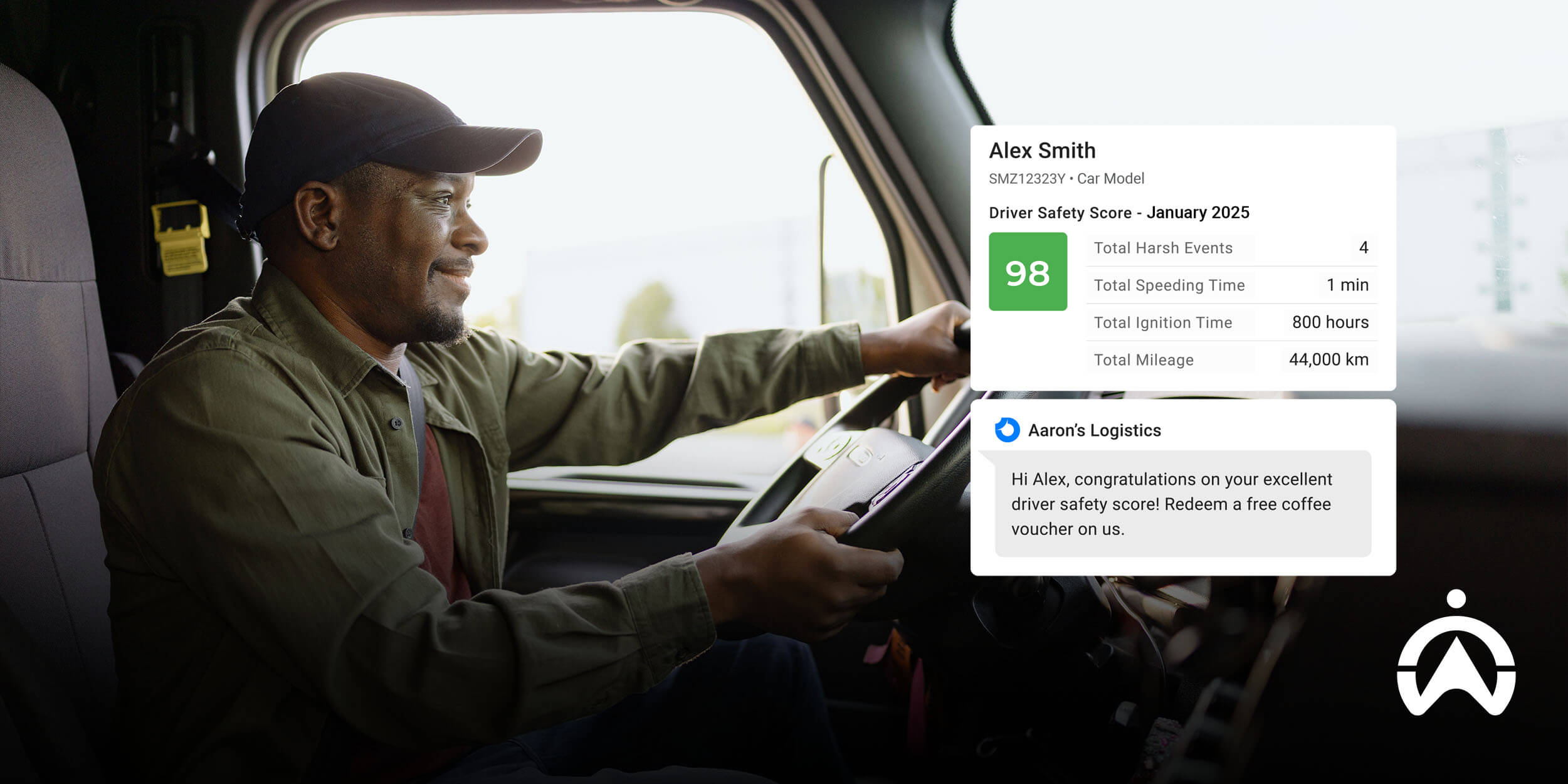
To boost driver safety with fleet gamification, you take mundane, everyday tasks and make them fun by implementing game-like mechanics. You incentivise your drivers’ tasks by introducing concepts like leaderboards, rewards, and point systems to motivate them. This helps and encourages your drivers to meet the necessary standards of improved safety, compliance, and other protection matters.
Gamification is a great way to keep your drivers engaged and motivated about doing the right thing. Statistics show that up to 80% of gamified platforms have more involvement from drivers, with 70% of employees saying they feel motivated by and enjoy the benefits gamification brings to their work. This keeps drivers encouraged and not closely monitored.
You can change the way your drivers see safety and compliance while building better relationships with them. In this blog, you’ll understand what gamification is, how to include it in your fleet strategies, and how Cartrack can make this a success for your business.
What does fleet gamification have to do with driver safety?
Fleet gamification has everything to do with driver safety and how you approach the safety culture within your business. Safety is always one of the most important aspects of a business, especially in logistics or delivery. So the question then becomes: how do you ensure your drivers are meeting safety standards without feeling mistrusted or under too much pressure?
This is why gamification is a powerful solution for your team. This strategy turns the mundane and boring into something to look forward to, becoming an encouragement for drivers rather than a source of stress. When drivers feel motivated to do better, they will do better, especially when they know that management isn’t breathing down their necks.
Gamification is also the key to keeping the driver safety strategies alive. To keep the motivation and encouragement flowing, you can adjust rewards based on the collective performance of the drivers. This means you not only maintain the enthusiasm, but you also carry out your initiatives successfully and without boring your drivers.
What are some of the driver safety risks that need attention?
Some of the driver safety risks that need attention include the various kinds of distracted driving, aggressive driving, and exhaustion management. For the sake of your drivers’ lives and your business reputation, paying careful attention to and correcting these behaviours should be your number one priority. This is where gamification comes in.
Distracted driving
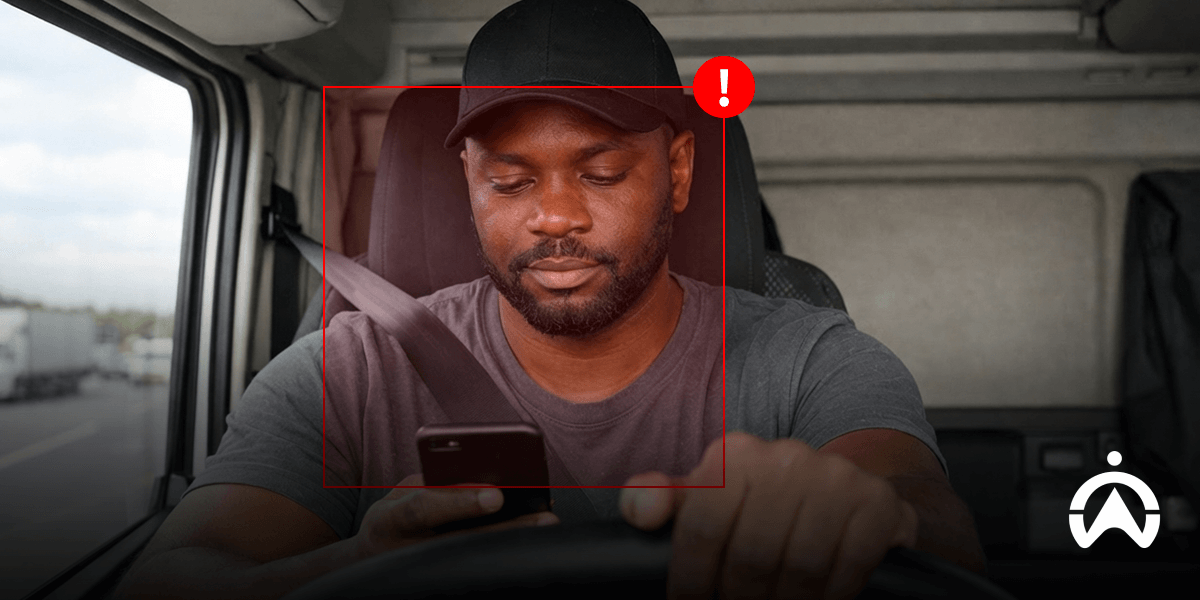
From using the phone and smoking, to eating while driving, these are some of the behaviours that need to be addressed from a typical driver management safety perspective. Distracted driving means your eyes are off the road, but even the quickest diversion could swiftly lead to an accident.
A gamified approach could do something like reward a top driver who has the least number of recorded events.
Fatigue treatment
Exhaustion must be correctly managed so that your drivers aren’t putting themselves, their lives, and the lives of others in danger. In addition to this, fleet vehicles and cargo could also be lost or damaged as a result of dozing off behind the wheel.
A gamified approach could reward drivers for logging enough rest stops or resting according to the guidelines set by your business.
Speeding and aggressive driving
Drivers who drive too fast, cut the corners they take, don’t follow the rules of the road, or just act unpredictably while driving are displaying total recklessness. This kind of behaviour not only puts drivers and other road users in danger, but also threatens your business brand.
Driver safety isn’t just about driving behaviours; it’s also about the condition of the vehicle and the care taken. Although proper and scheduled maintenance is mostly on your part as management (and your fleet system), a driver is still expected to do vehicle checks and inspections regularly to keep them safe.
A gamified approach could reward a driver for accurately completing full inspections for a prolonged time.
How can you implement gamification to meet these safety goals?
You can implement gamification to meet these safety goals by clearly and carefully introducing the strategy to your drivers. Everyone should be on the same page and understand how the point & ranking systems work, what the rewards & incentives are, and the importance of healthy competition.
At the end of the day, gamification works on the psychology of people and the favourable outcomes they create from positive feedback. Direct incentives and rewards are great, but soft rewards are just as important. Always remember to encourage your drivers, give them words of affirmation, and publicly acknowledge their achievements.
What are some examples of gamification in a fleet?
Examples of gamification in a fleet include displaying leaderboards, offering rewards and incentives, and openly praising drivers for their achievements. What’s even better? Our platform has API capabilities, meaning you can seamlessly connect any third-party tools or programmes you may decide to use for gamification purposes.
Check out these key examples:
Leaderboards: Leaderboards show the names and rankings of each driver, giving them the chance to see where they stand in comparison to one another. This facilitates healthy competition amongst the drivers and provides an opportunity for drivers to encourage each other.
Rewards and incentives: From cash and vouchers to time off, they’re an extremely effective way to motivate your drivers. With an exciting reward at the end, they may put in some extra work towards meeting safety and compliance goals.
Badges: Usually, these aren’t physical badges but rather an icon shown next to the driver’s name. This could signal meeting milestones, being employee of the month, or other notable achievements.
Collective performance: Although healthy competition is encouraged, it can also be great fun for your drivers to come together as a team and achieve goals together. Group efforts on top of individual ones can truly foster that overall safety culture. Drivers encourage each other instead, and everyone benefits in the end.
Praise and words of affirmation: As previously mentioned, acknowledging drivers’ achievements can go a long way to elevate their confidence. Public recognition can boost self-esteem, improve professional relationships, and help ease the pressures of the job.
How is gamification in fleets BETTER than traditional safety enforcement?
Gamification in fleets is better than traditional safety enforcement because it adds a level of excitement and incentive. When your drivers are engaged and rewarded, it’s likely they’ll want to meet compliance regulations and be safer on the roads. This combats traditional safety enforcement, which can be rather repetitive, frustrating, and discouraging.
Picture this:
You’re dealing with a driver or two who’ve been consistently triggering events via their AI-supported dashcam, from using their phones while driving to speeding. You give them another one of those long lectures and coaching sessions, and the repetitive, irritated nature of your feedback leaves your drivers upset and demotivated. They’re unhappy, you’re unhappy, and now tension sits heavy in the air.
This kind of tension can prove to be a disaster for you, your business, and the wellbeing of everyone involved. Professional relationships are fractured, safety is threatened, and employee retention is lower. All of this could ultimately be prevented if you considered introducing gamification into your fleet safety strategies.
What can Cartrack do to support your gamification goals?
Cartrack can support your gamification goals by being the trusted partner you choose for long-term success. At the core of gamification, you need a powerful and user-friendly fleet management system and sophisticated software that helps you identify the safety protocols and events that need addressing. We have all of that, and more.
Not only do we have a variety of dashcam options with AI capabilities, but we also have live GPS tracking with a strong connection, telematics, driver scorecards, API features, and much more. These are the tools and features you’d need to successfully manage gamification within your fleet, and we make it a simple process for you.
We want to help you make safety easy and completely achievable. We understand the impact of prevention before post-incident attention, and that’s why we’re here to accompany you on your gamifying journey and prove ourselves as long-term partners for your success.
Final takeaway: gamification as a catalyst for safety
At the end of the day, the well-being of your drivers and the way their safety is managed overall is undoubtedly one of the most important aspects of fleet management. You can still have a focus on safety policies, regulations, and compliance without enforcing traditional and redundant methods to achieve that safety.
Gamification could be the tool that sets your company apart from the rest, combining your concern for safety and compliance with deep care for your drivers and their overall health. When that’s achieved, your business becomes a flourishing, well-oiled, compliant machine that puts its people and safety first.
Are you ready to see how gamification can elevate your drivers and fleet? Speak to a Cartrack professional today and get started on a safer, smarter, and more entertaining strategy to achieve driver safety.
Frequently asked questions related to safety gamification in fleet management
What software should I get for managing my fleet?
The software you should get for your fleet incorporates GPS tracking, telematics, and AI capabilities, so that you get a complete and accurate overview of your fleet and its whereabouts. Cartrack’s FleetWeb is a perfect solution; we offer all of this and more for your traditional, electric, or mixed fleet.
What are 7 ways to improve fleet safety?
7 ways to improve fleet safety include:
introducing AI capabilities in your fleet management
adapting preventative maintenance
opting for gamification for your drivers
monitoring and coaching your drivers
having advanced dashcams and sensors
location-specific alerts & geofencing, and
managing driver permissions and driver tags
How do you effectively manage a fleet?
You effectively manage a fleet by bringing together the necessary hardware, software, and fleet strategy to optimise your fleet’s productivity. Hardware ensures you have the right devices; software collects and translates the data from the hardware; and a strong fleet strategy carefully maps out the planning and smooth execution of your operations.
The best tourism fleet management solution should offer you ways to save on your fleet costs, ways to simplify your operations, and keep your passengers safe. Passengers also have high expectations these days, and considering the competitiveness of the tourism industry, you want to implement technology that satisfies those expectations.
Namibia is one of Southern Africa’s most captivating holiday destinations, thanks to its dramatic deserts, abundant wildlife, and vibrant adventure tourism. According to the Namibia Tourism Board, the country welcomed approximately 1.5 million tourists in 2025, marking a steady rise in international arrivals. To cash in on this and ensure your business is the top choice for tourists, you must invest in proper fleet management software.
What makes tourism FMS the best is the software it has to offer. A lot of tourism fleet companies out there use outdated software that doesn’t really solve issues and is actually a waste of money. You need a system that makes use of things like AI to bring you a futuristic approach to managing your fleet.
What are some obstacles tourism fleet managers encounter?
Some of the obstacles that tourism fleet managers encounter include:
Fuel costs being way over the budget
Planning efficient routes takes time
Breakdowns while in transit
Driver misconduct
Customer dissatisfaction
This results in companies losing a lot of money and clients.
Here’s a closer look:
Fuel costs are going way over budget
High fuel costs can be caused by idling for too long, reckless driving, or fuel fraud & theft. But with no technology in place, there’s no way to pinpoint what exactly is causing these high fuel expenses. As fuel takes up a big chunk of daily operational costs, this can result in a big loss in revenue.
Planning efficient routes takes time
Figuring out the most efficient way to drive tourists around the city without leaving out monumental sites can be quite the challenge. There are things like traffic, road closures, and varying vehicle sizes that must be considered to determine the best way to go about each tour. This can be time-consuming and may result in a lot of human error.
Vehicles break down while in transit
Fleet managers often overlook things like booking vehicles in for service and ensuring that drivers check vehicle conditions before and after trips. This is especially true during peak seasons, when there’s “no time” to waste. By neglecting vehicle maintenance, you create a bigger issue of constant breakdowns. This leads to more downtime and expensive repair costs.
Driver misconduct
Knowing how drivers behave when carrying passengers is difficult. Some drivers speed through the trips and never obey road rules, leaving your customers terrified and not enjoying the ride. The worst thing that could happen due to bad driver behaviour is an accident where passengers get severe injuries, or even die as a result. Aggressive driving habits also lead to more vehicle wear & tear and an increase in fuel consumption.
Customer dissatisfaction
The tourism industry relies heavily on customer reviews, and in most cases customers only make public reviews if they’ve received impeccable or extremely horrible service. Customer reviews always make a huge difference, and we live in a time where social media makes the most impact. How many times have you seen a good review of a place on TikTok and thought to yourself, “Hmmm, I definitely need to try that”?
There are some small businesses that’ve literally skyrocketed in profits because someone went on the internet and shared their wonderful experience. There are also those whose businesses have hit complete rock bottom because of the power of social media.
What do tourism fleet managers actually need?
As a tourism fleet manager, you need technology that’ll help you make better decisions, save costs, and bring you more customers. This means investing in a reliable fleet management system that provides things like:
Live GPS tracking
Route optimisation software
Aggressive driving alerts
Fuel consumption reports
Digital maintenance reports
A vehicle booking system
Live GPS tracking
You’ll always know where your vehicles are if you have GPS tracking on them. If the driver is supposed to be picking up people at the airport and they’re not there yet, you’ll see what’s causing the delay. Our system shows you which vehicles are on the move, idle, or completely off. This gives you complete control over your fleet.
Software to help you plan better routes
Planning better routes means finding and exploring different ways for drivers to get to their destinations and choosing the best option. Route planning software speeds up that process, saving you time and giving you more fuel-efficient routes. Your drivers will experience less traffic and hiccups on the road, because this software usually factors in road conditions before giving its suggestion.
Aggressive driving alerts
GPS tracking units have telematics, which is a technology that can detect when drivers are driving recklessly. You’ll be notified of this and be able to address your concerns with your drivers. This also helps you see which drivers need training for improvement. When drivers know you’re watching, they’ll behave better, giving your customers a better experience.
Fuel consumption reports
With a fleet management system, you also get to see accurate mileage readings, cross-check fuel receipts with the distance travelled, and track live in-tank fuel levels. These features will show you exactly how most of your fuel is being wasted and if there’s any theft or fraud. A fleet management system is the best way to reduce fuel expenses, which are a large portion of operational costs.
Digital maintenance reports
Don’t wait for vehicles to break down before fixing them; be proactive! This means using fleet management software for up-to-date vehicle servicing and repairs. Through a fleet management system, you’ll also get warnings of potential mechanical failures, so you can fix them before they cause breakdowns. This saves you money that could be spent on unexpected repairs. It also helps to ensure your vehicles are roadworthy.
A vehicle booking system
Too many disconnected apps result in time being wasted going through the different platforms and aligning your plans. With a fleet management system, you’ll have the option of integrating your vehicle booking system with the platform, so you know which vehicles are booked and for how long. This helps you avoid booking clashes or missed cancellations. Alternatively, you can use the platform’s own booking system.
Understanding the connection between a bad tourism experience and your profits
Bad tourism experiences lead to more people being reluctant to use your services, which results in your business making less profit. Most of the time, this doesn’t happen overnight but rather slowly as more people experience unpleasant service and leave reviews. But in today’s world, where social media influences the choices of many, a massive overnight loss is possible.
Picture this: You have a group of eight friends who’ve booked your shuttle services to transport them to a popular festival in your city. The festival happens only once a year and features some big international artists. The people who booked your services flew from another city just to attend that event. The event is two hours away from their accommodation in a remote area (making e-hailing a not-so-fitting option).
1. Booking time confusion
Now comes the time to pick them up. Your driver gets there at 13:00 and calls to say he’s arrived. Your clients are puzzled because they scheduled a 16:00 pick-up, and they’re not even there yet.
You realise there’s a mix-up with the booking times, and the driver won’t get the chance to pick them up later because there are other clients to pick up and all your other vehicles are busy. Your clients are left angry and stranded because they have no other way of getting to the event.
2. The breakdown
A few hours later, after a long search, you finally see a gap and find a vehicle that’s available. Your clients are picked up at 18:00, meaning they’re already late. Just when you thought things couldn’t possibly get worse, the vehicle breaks down mid-transit, and the matter takes another hour to get resolved. By this time, you already know that some bad reviews are coming.
3. The review
But wait, it gets worse! Two days later, one of the people from that group recorded a video detailing all that happened on the day of the festival and how your shuttle services ruined their day. The video goes viral, and just like that, the whole world knows never to use your services. More people cancel the bookings they made, and your business takes a huge downturn.
How this could have been avoided
A fleet management system could have saved you from all that trouble with a proper preventative maintenance plan and a more accurate vehicle booking system that helps you avoid clashes.
Remember that your customers are humans who most certainly are understanding. If there’s one small hiccup, they might be a bit lenient because, hey man, life happens! But if they encounter too many issues with your service, you’ve lost them. You want to make sure you give every customer the best possible service, and that means trying your best to eliminate all potential issues relating to your fleet. That’s where fleet management technology comes in!
Why is Cartrack considered by many to be the best tourism FMS?
At Cartrack, we’re considered by many to be the best tourism FMS because of the solutions we offer. You can’t manage what you can’t see, and we help you see! Through our GPS tracker, cameras, and sensors, you’ll get a full view of everything relating to your fleet at the palm of your hand.
Here’s what we offer:
Route optimisation software
Our route optimisation software factors in things like traffic trends, road conditions, and the time your drivers have to get to their destinations. All you need to do is input the driver destinations, and the software will suggest the best options for your drivers to get there. These suggestions will most certainly be more fuel-efficient—and often quicker.
Carpool
The Cartrack Carpool feature is a vehicle booking system for shared company vehicles. It helps eliminate things like booking time confusion. It shows which vehicle is in use, what time it’ll be back, and which one hasn’t been returned on time. Drivers can either reserve the vehicles themselves, and then you’ll get a notification, or you can do it yourself. Carpooling is a great way to improve vehicle utilisation and keep up with vehicle availability.
If you prefer the booking system that you already have, you can integrate it into our system so you won’t have to go through too many apps to run your fleet.
MiFleet
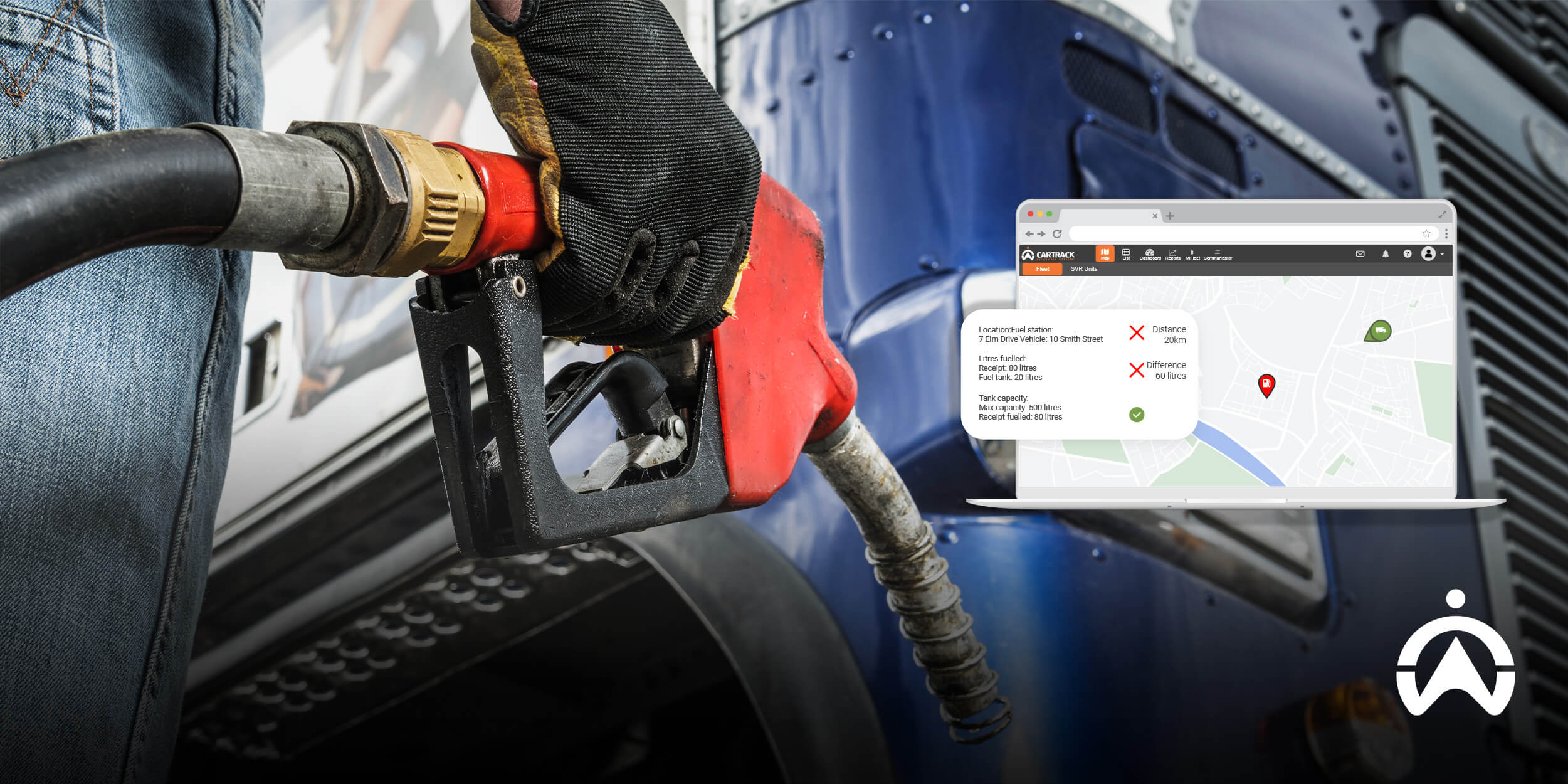
Being on top of things involves staying in control of operational costs. MiFleet is our cost management tool that you can add to your package to track the real cost of things like fuel, repairs, and toll fees. For example, you can use this platform to check for fraud. How? The software factors in refuel receipts, tank capacity, fuel station location, and distance to determine if the transaction is accurate. If the numbers don’t add up, it’ll flag the transaction as high risk.
Fuel sensor
Another way to stay on top of fuel costs is by installing our fuel sensors in each of your vehicles. These sensors will give you live fuel levels. If there’s a sudden drop in fuel levels, then you’ll know it could be due to theft or a leak. Fuel sensors help you stop theft, sometimes as it happens.
Preventative maintenance
Our preventative maintenance system ensures that your vehicles are always in good shape. You can start by importing all vehicle maintenance schedules onto our platform so we can give you reminders. From there, you can create a vehicle inspection checklist on our platform that drivers can use to inspect certain vehicle components before starting a trip. This ensures that all vehicles are safe to use, and you’ll get feedback so you know what needs to be fixed.
Our preventive maintenance system also alerts you to things like worn-out brake pads and engine faults. This is so you can quickly repair or replace vehicle components before they become a bigger issue and cause breakdowns.
Vehicle cameras
We have a selection of camera solutions you can choose from to ensure your drivers are safe on the road and that your customers are comfortable and receiving good service. For example, our AI Tri-Vision cameras enforce safe driving practices by detecting distractions like when drivers are on their phone or smoking. The cameras release audible alerts for such behaviours, so drivers can quickly make corrections and focus on the road.
Through our camera solutions, you can also ensure that your drivers aren’t picking up passengers who aren’t booked with your company during trips for personal gain.
Driver behaviour reports
Through our telematics system, you’ll get to see if drivers operate your vehicles safely. You’ll get reports of speeding, harsh braking, harsh cornering, and rapid acceleration. You’ll also be able to see when drivers idle for too long, which is another way that fuel goes down the drain. Through these reports, you’ll be able to address your concerns and promote safer and more fuel-efficient driving habits.
Geofence
With our geofence feature, you can ensure your drivers remain within their designated areas. This tool allows you to create virtual borders around areas of your choice, so you get alerts wherever your drivers enter or leave those areas.
Let Cartrack help you take control of your tourism fleet
Namibia is attracting more and more tourists, and your business needs to be at the forefront and ready to handle the large volume. With Cartrack by your side, you’re assured a safer, healthier, and more profitable tourism fleet. So reach out to us, and take us with you on your journeys.
Frequently asked questions about tourism fleet management
What are fleet management best practices in tourism?
Teaching your drivers basic customer service skills.
Monitoring fuel usage through sensors.
Investing in route planning software.
How do I measure fleet management objectives in tourism?
To measure fleet management objectives, you must look at important metrics like:
Total Cost of Ownership (TCO)
Vehicle utilisation rate
Fuel cost per kilometre
Repair turnaround time
Vehicle accident rate
Measuring these metrics correctly requires a fleet management system, which will also help you find better ways to run your fleet.
Is fleet management software really worth it?
Yes, fleet management software is most certainly worth it. It helps you save operational costs, prevent accidents, and remain compliant. Through a fleet management system, you’ll have full control over your fleet and therefore make smarter decisions based on the data you’ll receive.
To go from reactive to proactive safety in your fleet, you need to invest in an advanced telematics system with AI cameras. An advanced telematics system uses predictive maintenance to let you know what’s happening with your truck’s mechanical side, while AI cameras show you how your drivers are behaving behind the wheel.
It’s Monday morning, and just before you’re about to take a sip of your coffee, your phone rings—one of your trucks carrying really expensive cargo was just in an accident because the brakes failed.
Now the absolute nightmare begins between your client waiting on their shipment, making sure your driver is okay, calling your insurance company and dealing with the police. If this sounds familiar or like something you’re constantly anxious about, it’s time you move from reactive safety in your fleet to proactive safety.
According to estimates from Namibian transport authorities, road accidents impose a significant economic burden on the country, potentially costing around 1–2% of Namibia’s GDP each year—which further proves that switching from a reactive to a proactive system is not only beneficial for your operations but for the economy too.
So what do these economic issues have to do with fleet owners in the B2B industry? Well, this can increase your insurance premiums—costing you more in the long run. So, if you’re interested in shifting your entire fleet from a reactive mind-set to a proactive one, you need to focus on three things:
Real-time visibility
Predictive technology
Coaching-first culture
This blog breaks down exactly how to change your ‘wait for the shoe to drop’ method to making sure those shoelaces are tied in a neat little bow, never unexpectedly making you trip.
The reactive cycle
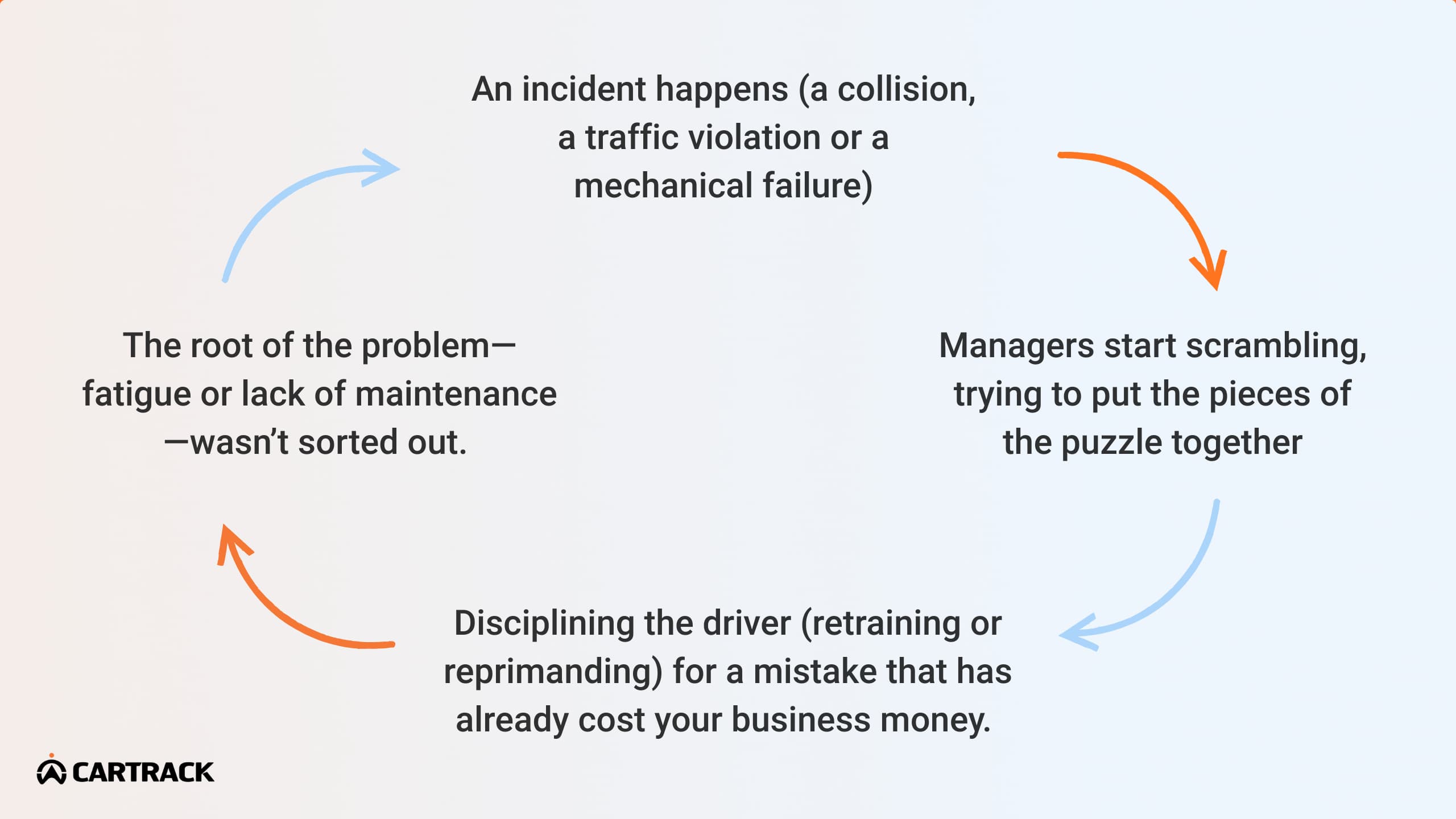
Businesses that don’t have proactive safety measures in place are often stuck in this reactive cycle. The cycle starts with an incident happening and your team working to find out what exactly happened. Then managers start reprimanding drivers, and at the end of the day the root of the problem hasn’t been sorted out, so the cycle starts again.
What fleet managers and business owners need to understand is that the main risk to your business is not higher insurance premiums, unexpected maintenance costs or downtime. The biggest risk to your business with only having reactive fleet safety in place is the damage it’ll do to your brand image and your drivers’ wellbeing.
What is the proactive safety approach?
The proactive safety approach is when you have tech like dashcams and advanced telematics installed in your fleet that helps in preventing accidents or unexpected breakdowns. This approach is the best way to keep your business profitable, your drivers safe and your clients happy.
Imagine you’re at work on Friday afternoon after a long week, and you have exactly 5 mins before you clock out for the day when the phone rings… You’re hoping it’s just your wife calling you, asking to get some bread before you come home. Unfortunately, it’s the police calling to let you know that your 18-wheeler truck was just in a major accident and your driver (who has been with you for the past 6 years) has passed away.
The brakes of your truck failed. It crashed on a downhill into another car, and there are multiple fatalities. The worst thing that can happen has officially happened, and it could have been avoided, but your fleet isn’t equipped with proactive safety tech. Now, you’re dealing with insurance, the police, a lawsuit, and a grieving family and team.
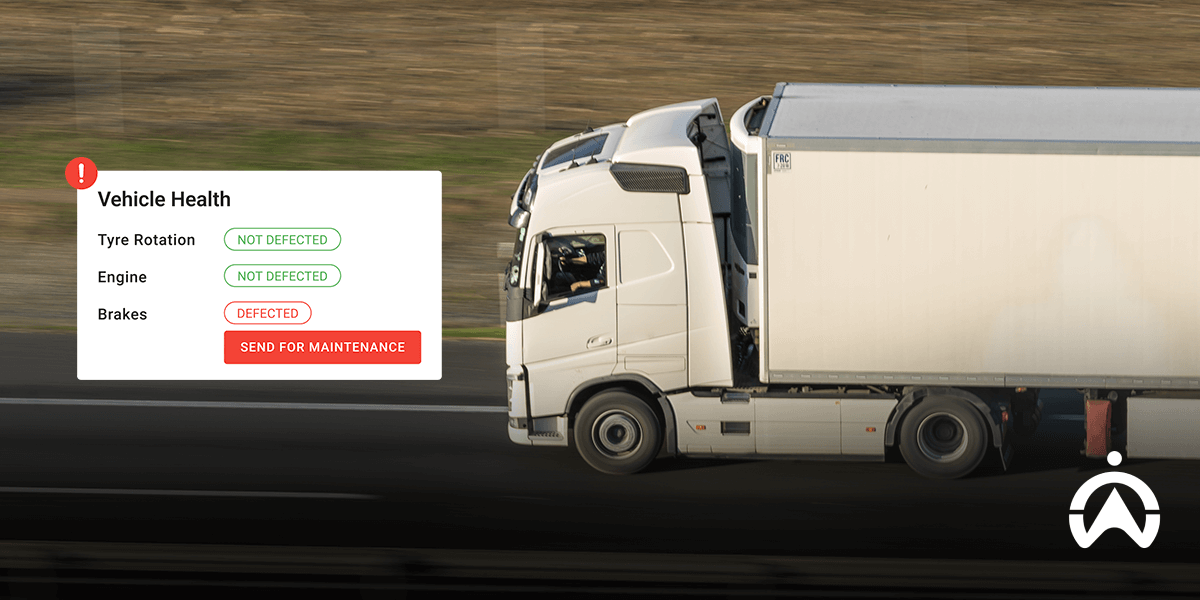
Having a telematics device installed could have alerted you two weeks ago that the brakes on that truck needed to be replaced and that your driver was constantly speeding. So you could have had time to change the brakes and coach your driver on his bad speeding habit, preventing all the events that followed.
The 3 characteristics of a proactive fleet
There are three main characteristics to having a proactive fleet; these are predictive intelligence, condition-based maintenance and having a coaching-first culture. When you implement these three things in your fleet, you improve the safety of your vehicles and your drivers, and overall, you improve your ROI.
1. Predictive intelligence (foresight)
Instead of you looking at GPS breadcrumbs to see where a driver was when they were speeding, a proactive fleet uses AI to monitor micro-behaviours.
The goal: To catch the yawn (fatigue) or the downward glance (distraction) seconds before it leads to a lane swerve.
A proactive fleet doesn’t wait for the check engine light to go on or for a driver to report a “funny noise”.
The goal: To eliminate unplanned breakdowns that cause delivery delays and safety hazards.
The tech:CAN-bus integration that monitors engine health, tyre pressure, and brake wear in real time, triggering a service alert the moment a part begins to change from its normal performance.
3. A culture of coaching-first
So instead of just dishing out warnings left, right and centre to your drivers who make mistakes. Rather take the data you get and proactively coach your drivers to create better driving habits.
The goal: To lower insurance premiums and raise employee morale.
The tech: Make use of driver scorecards and gamification that motivates your drivers to have safer driving habits.
Overcoming the “big brother” culture shift
The biggest hurdle you’ll probably face with introducing proactive safety measures in your fleet is pushback from your drivers. They might feel like you don’t trust them or even feel uncomfortable being constantly “watched”. The solution to this is transparency.
Proof of innocence: Show drivers footage where AI cameras proved a driver wasn’t at fault in a dispute.
Privacy: Clarify that AI fatigue monitoring isn’t spying—it’s a life-saving tool that only records high-risk events.
Here’s real video footage from a Cartrack dashcam of a recent accident that helped prove a trucker’s innocence in a fatal accident:
How can Cartrack help you with proactive fleet safety?
Cartrack can 100% help you with proactive fleet safety thanks to our years of experience and world-class technology. Features such as AI-powered visibility, real-time coaching, predictive maintenance and driver scorecards all help to move your fleet from a reactive one to a proactive one.
Visibility and real-time coaching
At Cartrack we have some really high-tech AI-powered cameras that will be the backbone of your shift to being proactive with safety in your fleet. This is because our cameras process information super fast and will be able to not only alert fleet managers of these events but also immediately alert the driver so they can self-correct.
How is this proactive?
If you don’t get real-time alerts to risky driving behaviours and your system only tells you once you pull a report, you can only coach your driver after they’ve done something that has put their life and the lives of others at risk.
This is basically pointless. Having a system that alerts you and your driver immediately allows both of you the opportunity to fix the problem while it’s actually happening. Not only can you correct behaviours, but it can also give you valuable insights into your drivers.
Let’s say you review footage and reports, and you see that every Wednesday, over the past three weeks, your driver David is constantly yawning and showing exhaustion (which is a safety risk). You’re now able to discuss with him that this is a pattern you’ve noticed and find out what’s going on in order to find a solution that works for both of you.
The result? An employee who feels seen and taken care of, and the peace of mind knowing that no accidents are going to happen because of David dozing off behind the wheel.
Driver scorecards and gamification
One of the biggest struggles you’ll have with a reactive strategy is getting your drivers to make safer habits while on the road. A proactive approach will help with this. At Cartrack we’ll provide you with a fun tool called ‘driver scorecards’. This will help you, as the fleet manager, see where your drivers are going wrong and can let your drivers actually see how many times they’re making the same mistakes.
This approach will create a culture shift when it comes to safety and how unsafe driving is handled.
So how do driver scorecards work?
First, all your drivers start off with a score of 100, and then points are deducted based on the infraction that occurred. What this means is that a driver with a low score is your higher-risk driver and is a hazard to your operations.
Another bonus is that as the fleet manager, you have the power to create your own rating system, so if you feel that distracted driving (like using the phone or eating while driving) is a very high-risk event, you could make the rating for this 35, while harsh acceleration to you is considered a low event and has a score of 1.
What is the benefit of driver scorecards?
Having these scorecards shouldn’t be there to stress you or your drivers out. It should work as a tool that helps to bring awareness to bad driving habits and helps your team to want to be safer on the road.
Ultimately using driver scorecards will benefit the company as a whole, because if your drivers are driving well, it’ll build a positive brand image around your trucks (who notoriously have a bad reputation on the roads).
How does gamification work?
People love rewards. When you incentivise good driving, you’ll have more good drivers. So think of an incentive that works with your drivers, and let the healthy competition start.
Types of incentives could be:
Cash bonuses
Half day off
Free meal from the company
By adding gamification into your fleet, your drivers will be motivated to have better driving habits, without the constant need of management keeping them in check. Gamification and scorecards will help keep your cargo, trucks and drivers safer.
Fun fact: the scorecard is free with all of our fleet management systems!
How does proactivity improve your business’s ROI?
Proactivity can improve your business’s ROI by lowering the chances of accidents and breakdowns that all drain profits. According to industry data, reactive fleets are 65% more likely to experience a crash compared to those who have proactive safety systems in place.
To help you visualise all this, think of the Heinrich Pyramid. This pyramid is based on the law of probability: “In a workplace, for every accident that causes a major injury, there are 29 accidents that cause minor injuries and 300 accidents that cause no injuries.”
And we can look at this with your fleet as well; for every one major accident that happened, there were 300 near misses. Having proactive safety measures in place focuses on the 300, making sure that 1 never happens.
A story of chaos to control
To make all of this wonderful but weighty information just a little more digestible, here’s a fictional but very probable story of how switching from a reactive fleet to a proactive fleet with Cartrack can improve your business. This is a story of a logistics company called Mobile Movers (a made-up example of a Cartrack client).
Mobile Movers has been experiencing constant issues with their fleet, from speeding tickets and drivers who are constantly quitting to unexpected downtime from random breakdowns. All of these lead to the company losing time and money.
They then decided to sign up to get Cartrack’s telematics tech, which is linked to the vehicle’s CAN-bus system and AI Live Vision cameras. Now they have predictive maintenance that alerts the fleet managers of everything that’s happening with the vehicle and when they should book the trucks in for a service.
With the AI cameras, the fleet managers can now see what’s happening in and out of the vehicle. Their drivers can now prove their innocence in an accident and have the ability to self-correct when they make a mistake on the road, like being distracted or falling asleep.
Thanks to driver reports, fleet managers can now support their drivers and positively coach them to make safer driving habits and implement gamification to incentivise better driving. This proactive approach has made the drivers at Mobile Movers feel seen and protected, meaning that fewer drivers quit and chose to stay where they were seen as a person and not a number on a sheet.
The competitive advantage of certainty
Having a proactive safety system in your fleet is a sure way to have a competitive advantage—of certainty at least. If your fleet is waiting to react to problems as they arrive, there’ll be an endless list of problems every single day.
But when you handle the safety of your fleet proactively, your list basically becomes nonexistent because you can see a problem from a mile away and stop it in its tracks.
So don’t wait for the call of the next incident; call Cartrack and let us help your fleet see around the corners.
FAQs
Will proactive safety tech lead to higher driver turnover?
No, proactive safety tech shouldn’t lead to a higher driver turnover. It should help with keeping your drivers exactly where they are. But this is really up to you as the fleet manager or owner. If you’re using the information to positively coach your team and not to punish them, they should feel safer and cared for.
Is proactive safety only for large, enterprise-level fleets?
No, proactive safety is not only for large, enterprise-level fleets. In fact, smaller businesses would actually benefit the most, as they don’t have the financial cushioning to help when a vehicle is in a major accident or has unexpected downtime because of a mechanical breakdown.
How do we ensure our fleet data doesn’t become a cybersecurity risk?
To ensure that your fleet data doesn’t become a cybersecurity risk, get a provider (like Cartrack) that uses end-to-end encryption and stores data on top-tier secure servers. Proactive systems enable you to only allow authorised staff to access sensitive driver footage or vehicle locations, keeping your operational intelligence safe.
Short-haul trucking is the transportation of goods via truck, over distances that are comparatively shorter than long-haul trucking. Usually, it refers to truck transport over distances of 100 km to 300 km, typically connecting towns or regions within Namibia.
According to Namibian road safety reports, in 2023, hundreds of truck-related fatalities were recorded, with a notable portion involving pedestrians. This highlights the significant role of short-haul trucks in urban, suburban, and rural areas. Can accidents like these be reduced without compromising speed and efficiency?
In this blog, Cartrack will do more than answer the question, “What is short-haul trucking?” We’ll create a comprehensive industry guide and help you develop your own short-haul trucking operations to make it more profitable, more reliable, and more efficient.
What does short-haul trucking refer to?
Short-haul trucking in Namibia refers to any truck-driven transportation that covers less than 300 kilometers. It’s a huge and important industry that includes last-mile deliveries, retail distribution, and manufacturing supply. Construction and infrastructure logistics are also included as industries that rely on short-haul trucking, as well as the all-important cold-chain logistics that regularly supply our retail stores.
How does short-haul trucking differ from long-haul trucking?
Short-haul trucking differs from long-haul trucking in distance, duration, and usually the type of truck used. Those large trucks you see on cross province highways are usually driven by long-haul truck drivers, while short-haul trucks often (but not always) use smaller vehicles.
Distance
Long-haul trucking usually covers long distances that cross from one province to another. Sometimes they even cross the border into neighbouring African countries. More often than not, short-haul truck drivers remain within their province and distribute goods to destinations that are relatively close.
Duration
A big difference between long-haul trucking and short-haul trucking is how long it takes for the delivery to happen. Long-haul truckers often work long, taxing hours navigating the road, which is why you might see them parked on the side of a highway sleeping or eating before moving again.
Vehicles
Because logistics companies want to get as much of their goods from one place to another (in order to save on fuel), long-haul truck drivers often work with large, heavily-loaded trucks. Short-haul truckers do too, but it’s more common for them to drive smaller trucks that carry fewer goods.
Regulations
Both long-haul & short-haul truck drivers must adhere to appropriate regulations respectively that might differ slightly. For example, long-haul truckers might have to pack and secure their loads in a certain manner, whereas short-haul truckers are travelling short enough distances to be less strict in this regard.
A day in the life of a short-haul trucker
A day in the life of a short-haul truck driver comes with its own unique set of perks, challenges, and nuances. It’s different for everyone, but most must work long hours that start early and end late. They also have various responsibilities that relate to their vehicles, their driving behaviour, and their deadlines.
What are the challenges faced by short-haul truck drivers?
The next time you see a short-haul truck driver on the road, consider the challenges they deal with on a daily basis:
Truck maintenance and road compliance
Tight deadlines for reaching their destinations (without breaking road laws)
Keeping the condition of their cargo in good shape
Ensuring vehicle security when parked
Navigating multiple stops in a single day
Dealing with traffic and the worsening road infrastructure
How is technology shaping the short-haul truck industry?
Fleet management companies have attempted to address many of these problems, and Cartrack has managed to come to the forefront of solving them ALL. Technology (in the form of telematics, AI-powered fleet software, and IoT (internet of things)) is evolving fast, and we’re the company in Namibia that’s driving it!
Just look at the ways we’ve made short-haul truck driving more efficient, safer, and more profitable:
Cartrack has developed predictive maintenance scheduling to keep short-haul trucks in peak condition, reducing downtime, reducing fuel use, and increasing overall vehicle efficiency.
We’ve developed the most refined route optimisation software that takes traffic, road conditions, and temporary roadblocks into account.
Our vehicle security cameras keep an eye on your cargo, automatically switching on and off based on your settings (whether the door is open, whether the vehicle is running, etc.)
Our vehicle cameras come with a “parking mode” setting, switching on automatically if the cameras or your vehicle is tampered with.
Short-haul truck owners will love our fuel management software that tracks fuel use and enables you to make changes that can save up to 24% of your fuel expenses.
Now imagine having these features for your own short-haul truck company. Imagine the increase in profits, the satisfaction of your drivers, and the improvement in your reputation in the eyes of your customers!
Give us a call to discuss the implementation of these features for your short-haul fleet.
Why is short-haul trucking vital to the economy?
Short-haul trucking is vital to the economy because it forms the backbone of construction, infrastructure, and last-mile delivery. It’s short-haul trucks that stock our retail stores, deliver essential materials for building, and deliver our online store packages. Without this vital chain in supply, our economy would come to a virtual standstill.
It’d be difficult to think of an industry in Namibia that isn’t supported by short-haul trucking. But for the purposes of this read, let’s just look at a few.
That last-mile connection
That online shopping you do is a drop in the ocean compared to the myriad industries that rely on last-mile deliveries. This is the final part of any delivery before it reaches the end consumer, and includes retail, manufacturing, printing, cold-chain, appliances, and many more.
The short-haul EV experiment
The interesting thing about short-haul trucks is that they’re the perfect sector for electric vehicle experimentation. Why? Because the distances are relatively short, and troubleshooting can be dealt with much easier.
EV trucks are being seriously considered for future short-haul trucking. At this point, small delivery scooters and electric bikes are being used to completely bypass fuel costs. Can you imagine the savings if this could be extended to small & large trucks as well?
Small trade companies
Plumbers, electricians, roof repairmen, and other trades rely on short-haul trucking for their supplies, materials, and even their tools. Can you imagine how your area would come to a standstill if there was no one to fix the essentials at your home?
Tips for short-haul truckers in Namibia’s demanding work environment
At Cartrack, we talk to truck drivers of all kinds. We listen. We learn. We put ourselves in their shoes. As fleet software developers. We’re always trying to make their lives easier & safer, while optimising the operations side of things for their managers too.
Here are some tips for short-haul truck drivers (and the hard-working individuals who manage them):
Tip #1: Focus on strategic route planning rather than speed
Tip #2: Stay safe and drive responsibly
Tip #3: Know your vehicle and how to keep it in good condition
Tip #4: Prepare by being well rested and nourished
Strategy vs speed
A map application on your phone can give you the quickest route to a destination. But only route optimisation software gives you time-based, road-based, and event-based route optimisation that’s applicable to each driver while they’re working.
Responsible driving
Cartrack has simplified driver coaching with AI cameras and GPS tracking that detects little things like:
Harsh cornering
Sudden braking
Distracted driving
Seatbelt use
Fatigue
If you see a gap in the way you drive your short-haul truck, your managers can focus their training based on the things you struggle with most.
Vehicle health
AI has come a long way to make vehicle maintenance a much easier task. A calendar app can schedule short-haul truck maintenance, but only fleet software coupled with AI can PREDICT when a vehicle needs its next service.
Driver health
You’ll be the best version of yourself if you’re well-rested and energised for the day. Eat a nutritious meal before starting your day, and always ensure you go to bed at a reasonable time. Remember that eating, drinking, smoking, and nodding off have no place in the worklife of a truck driver. Stay safe out there, and if possible, rely on technology that detects these warning signs and warns you while you’re driving.
Partner with the company that keeps driver safety and vehicle health a priority. Consultants are standing by to help you develop the perfect FMS package for your fleet.
Frequently asked questions about short-haul trucking
How many hours is a short haul?
A short haul can take anywhere between 1 and 5 hours, depending on the area being travelled, the conditions of the road, and traffic congestion. Short-haul trucks are designed to travel relatively shorter distances compared to long-haul trucks, so a reasonable speed, cargo space, and manoeuvrability are key to choosing the right short-haul truck.
What is the average salary of a truck driver in Namibia?
The average salary of a truck driver in Namibia ranges from approximately N$8,000 to N$33,000 per month. The variation is based on experience, working hours, and the type of cargo being transported. Some truck drivers work long hours and are compensated for the stress and pressure of meeting their deadlines.
What is the difference between trucking and freight?
Trucking refers to the mode of transportation while freight refers to the cargo itself. If you’re talking about trucking, you’re pointing to road travelling with a truck while carrying a load on board. If you’re talking about freight, you could be referring to any product load in the context of ships, trains, planes, or road vehicles.
What are the challenges of long-haul trucking?
The challenges of long-haul trucking include long hours, limited vehicle manoeuvrability, and delivery pressure. Long-haul truckers also need to manage their time well, since they get very little time to eat, rest &; recharge, or use the restroom. Many are permitted to stop mid-travel and rest along the side of the road if their route is extra long.
If you’re looking at buying a dashcam and wondering, “Can a dashcam record inside the vehicle?” The short answer is yes, but only certain models can do this. Most dashcams record the road ahead, but advanced models with dual-lens and 360-degree capabilities capture both street scenes and the inside of your vehicle, giving you extra protection and peace of mind.
This matters because Namibian roads can be extremely unpredictable. In fact, according to road safety data from Namibia’s transport authorities, over 400 fatalities were recorded in road traffic accidents between January and November 2025, with 431 deaths reported during this period.
So whether you’re driving to work, doing the school run, or even working as an Uber or Bolt driver, having clear video evidence can make a world of difference if something goes wrong. If you want a dashcam that does it all, then Cartrack’s AI-powered dashcams with live stream camera technology will be useful for everyday drivers like you.
Do dashcams record inside the car?
Yes, dashcams can record inside your car. However, only certain models can. 360-degree and dual-vision dashcams are designed to record the inside of your car as well as the road. In order to record clearly (even in the dark), they typically have two cameras: one facing forward and the other inward. Advanced models usually have night vision.
This is particularly helpful for:
Drivers for e-hailing services (such as Uber, Bolt, etc.)
Parents keeping an eye on their children while they drive.
Owners of businesses that oversee fleet vehicles.
Regular drivers seeking additional peace of mind.
Benefits of recording inside the car
The benefits of recording inside your car are that an additional sense of security and responsibility is added by having a dashcam that records inside the vehicle. It provides you with a clear picture of what goes on inside your car, which can be just as important as what happens on the road.
Security: You can prevent theft and vandalism and record any events by recording what happens to your car while it’s parked.
Capturing memorable moments: Dashcams can help capture any unexpected memorable moments from your travels!
Are there drawbacks to recording inside the car?
Yes, there can be some drawbacks to recording inside your car such as privacy, storage, high costs and installation challenges. While not all drivers will be impacted by these, it’s crucial to consider them before investing in a more advanced device.
Privacy concerns: Some passengers may find it uncomfortable to be filmed.
Storage issues: Additional storage may be required because two cameras produce more footage, which calls for a larger memory card.
Higher costs: Compared to standard models, dual and 360-degree dashcams are more expensive.
Installation challenges: Installing cabin cameras requires proper positioning and possible professional installation.
Different types of dashcams and what they record
It’s important to note that dashcams come in different shapes and setups, and not all of them can record the inside of your car. So before you swipe your card, be sure you’re getting the right one for you. The table below breaks down the main types of dashcams, what they capture, and how much you can expect to pay in Namibia:
Dashcam Type
What It Records
Inside the Car?
Typical Use Case
Front-facing
Road ahead
No
Everyday drivers needing accident evidence
Dual-vision
Road ahead & inside cabin
Yes
E-hailing drivers, parents, business fleets
Rear dashcam
Road behind
No
Extra coverage for parking or rear collisions
360-degree
All angles inside & outside
Yes
Premium option for full coverage and peace of mind
Choosing the right dashcam for you
When choosing the right dashcam for you, you need to consider your driving habits and lifestyle. This will determine which dashcam is best suited for your needs. While some drivers require full coverage with additional features, others only want a basic road-facing camera. You can compare features using the following guide to determine which one best suits your needs.
Feature
Why It Matters
Who Benefits Most
Interior recording
Captures what happens inside the car
Parents, Uber/Bolt drivers, fleet owners
Night vision
Clear footage in low light or at night
Long-distance drivers, city drivers with night shifts
Wide-angle lens
Covers more of the road or cabin
Anyone wanting fewer blind spots
Audio recording
Records conversations and sounds
Taxi/e-hailing drivers, security-conscious users
GPS tracking
Logs speed and location of trips
Businesses, parents, and insurance purposes
Cloud storage
Protects footage even if the dashcam is stolen
High-crime areas, business fleets
Parking mode
Records when the car is parked or unattended
Everyday drivers
Ease of installation
Saves time and setup hassle
Everyday drivers, first-time users
How dashcams protect drivers
Dashcams protect drivers from the unique risks associated with roads, which include smash-and-grabs, hijackings, fraud, and accidents. Although a dashcam won’t prevent these incidents, it can provide you with important proof to defend yourself later on, whether for peace of mind, insurance, or police reports.
For example:
Disputes can be swiftly resolved with accident footage.
Video footage makes it easier to report smash-and-grab incidents.
Drivers can defend themselves against false allegations.
Tips for using a dashcam effectively
Choosing the right dashcam is just the first step. You must install and use it properly if you want to get the most out of it. Your dashcam will always function when you need it most if you follow a few simple routines.
Make use of a memory card with 64 GB or more of quality.
Make sure the camera is positioned correctly to prevent sun glare.
Don’t rely solely on the memory card; make a backup of any important clips.
Think about hardwiring your dashcam or using an external battery if it has parking mode.
Let passengers know that recording is underway.
At Cartrack, we offer premium-quality dashcams at affordable monthly rates, complete with free installation. Contact us today to get the best dashcam solution for personal or business.
FAQs
Do dashcams record sound as well as video?
Yes, many modern dashcams record sound as well as video through built-in microphones. This can be useful if you need proof of what was said during an incident. If you’re not comfortable recording sound, most devices allow you to turn the audio feature off.
Can dashcam footage be used in court or for insurance claims?
Yes, dashcam footage can be used to support insurance claims or even as evidence in court. Clear video clips help settle disputes about who was at fault in an accident. Insurance companies are more likely to process claims quickly when you provide reliable footage showing exactly what happened.
Will a dashcam drain my car battery?
No, a dashcam won’t necessarily drain your car battery, this is because when you’re driving, dashcams usually run on the car’s power supply and use very little energy. However, dashcams with parking mode can continue recording while the engine is off.
How long is footage stored on a dashcam?
Dashcam footage can be stored anywhere from a few hours to a few months. Dashcams use loop recording, which means old footage is automatically overwritten when the memory card is full. The length of time footage is kept depends on the card size. With a 64GB card, you can usually store several hours before files are replaced, unless you manually save clips.
Do I need a special dashcam for Uber or Bolt driving?
Yes, for Uber or Bolt drivers, an AI dual-lens dashcam is the best choice. It records both the road ahead and the inside of the vehicle, which helps protect you against false claims or disputes with passengers. Some models even include night vision, which is useful for evening and late-night trips.
Some strategies for fuel reduction include route optimisation, fuel probes, preventative maintenance, telematics systems for driver monitoring and stopping unnecessary idling. If you’ve got a fleet, the chance that you’re looking for strategies to reduce fuel is probably pretty high.
And if you’re not, Namibia’s fuel trend should get your attention. Data shows that between 2020 and 2026, fuel prices in Namibia have increased significantly — with petrol rising by 72.5% and diesel by 65.9%, largely due to global oil cost pressures and import dynamics.
These stats prove just how important it is for fleet owners to find ways to reduce fuel usage as much as possible so that your profits can still remain high. At Cartrack we know how important this is to you. In this blog we’ll break down the top strategies for fuel reduction and how we can help you keep your costs low and your profits high!
What are the top 7 strategies to reduce fuel in your fleet?
One of the main strategies to reduce fuel wastage is by installing fuel probes in your vehicles. This is how they work:
The probe floats in your fuel tank and measures your fuel levels
It send a message to your fleet pages letting you know when your tank is almost empty and when it’s being topped up
If fuel suddenly drops when the vehicle isn’t in use, you’ll get an alert
Fuel probes make sure that as the fleet manager, you’ll always know what’s happening to the fuel in your vehicles.
2 – Optimising your routes
Something you may not be aware of that’s wasting your fuel is the routes your drivers are using. By installing an advanced GPS system, you’ll be able to optimise the routes your drivers take.
You can save fuel with GPS-assisted routes by:
Avoiding high-traffic routes that keep your drivers sitting idle
Maintenance is often overlooked as a reason for fuel loss. Factors such as:
Underinflated tyres
Clogged air-filters
Old oil
Worn-out spark plugs
Dirty fuel injectors
All of these cause your vehicles to not run optimally and end up wasting fuel. When you implement a telematics system that assists you with predictive maintenance, your fleet will be on top of their game!
Preventative maintenance warns you of all the issues mentioned above before they actually start to affect your fleet. Not only saving you fuel but time as well!
4 – Stop idling
Idling burns your profits and fuel. Don’t believe us? Check this out:
According to WearCheck, an 8000 cc diesel truck idling at 650 rpm burns about 0.8 litres per hour. If you have a fleet of 50 of these trucks and each idles for around 1 hour per day, they could waste up to 40 litres of diesel daily. Over a full year of operations, this adds up to approximately 10 000 litres of fuel, which at typical Namibian diesel pump prices of around N$19.58 –20.23 per litre in early 2026 could cost your fleet roughly N$201 300–202 300 annually in wasted fuel — a significant avoidable expense that proper idle management and driver training can reduce.
5 – Driver gamification
Your drivers play a major role in ensuring fuel isn’t being wasted. By motivating them through gamification, you can achieve this.
You can motivate and create healthy competition in your team through:
Cash incentives
Days off
Free meals
Recognition (Driver of the month)
6 – Using the right-size vehicle
A common oversight that wastes fuel is not using the right-sized vehicle for deliveries. This means not using your heavy-duty truck to deliver one fridge and not overloading your bakkie with all the stock in your warehouse.
Both overloading a small vehicle and underloading a heavy vehicle cause you to waste fuel and damage the lifespan of the vehicle.
7 – Installing a fuel management system
A fuel management system is the best way to monitor fuel usage in your entire fleet. By having the data all in one place, it makes your job as a fleet manager so much easier as well! And the best thing? This system can assist with almost all of the above strategies!
How to turn data into diesel with Cartrack’s MiFleet
With Cartrack’s value-added MiFleet software, you’ll be able to turn your data into diesel. How? Well, according to studies, fleet management tools like MiFleet can reduce your fuel costs by up to 15%! MiFleet matches fuel spend with telematics data to pick up fuel usage patterns, so you’ll be able to easily detect excessive idling and fuel fraud.
MiFleet reduces admin mistakes
Unfortunately small errors can cost your business thousands. Lost slips or manual typing errors when calculating the entire fleet’s fuel spend are common mistakes that businesses face.
MiFleet stores all of your fleet costs and important documents in one place. Your drivers can snap a pic of their fuel slip, fuel gauge and the fuel pump readings on the driver app. You can then instantly approve or flag the transaction.
This makes your life less complicated, because all fuel slips will be automatically uploaded onto your dashboard, meaning no more lost slips and no more manual data entry errors!
MiFleet will keep track of the data and let you know in advance which truck is due for what. This means your trucks will always be running at peak efficiency, ultimately lowering fuel usage across your entire fleet!
If you’re ready to stop guessing where your gas is going, contact us today so we can take every byte of data in your fleet and turn it into extra kilometres on the road!
FAQs
Does the type or quality of fuel really impact my fleet’s consumption?
Yes, the type/quality of fuel does really impact your fleet’s consumption. Lower-quality fuel usually has water and dirt in it, which will damage your fuel injectors. This means you’ll end up forcing your engine to burn more fuel to keep up its power.
How much does “hidden” vehicle weight really cost me?
Hidden vehicle weight can reduce your fuel economy by 1% for every additional 45 kg added to the vehicle. So try not to keep any unnecessary equipment in your vehicles, and encourage your drivers to keep their trucks clean, because even the weight from dirt and debris can play a role.
Beyond driving habits, what “silent” operational factors affect my fuel bill?
Beyond driving habits, the most common “silent” operational factor that affects your fuel bill is poor weight distribution. If you unevenly load a trailer, you’ll affect the vehicle’s aerodynamics and increase the resistance on some of your tyres, meaning more fuel will be used.
Fleet electrification is the process of gradually transitioning your fleet from traditional ICE (internal combustion engine) vehicles to EVs (electric vehicles). You’ll need a roadmap for this process because of the scale of the transition. You’ll also want to successfully manage the uncertainty of this change without taking an unnecessary hit to the pocket.
According to the International Energy Agency (IEA), the end of 2024 showed that we can expect the number of EVs to triple by 2030. It’s a clear indication that there’s a demand for EVs in businesses to be met, and delivery & logistics companies are moving toward greener operations.
In this blog, we’ll help you tackle the unknown and put you at ease about taking the first step to electrification. Let us guide you through what electrification means, give you a practical breakdown of the step-by-step roadmap, and explain how Cartrack can help you take the electrification leap.
What is fleet electrification, and why does it need a roadmap?
Fleet electrification refers to the process of transforming your fleet of ICE vehicles to EVs. This is typically a gradual process, taking up to years at a time, and usually resulting in a mixed fleet. Fleet electrification needs a roadmap because roadmaps are a meaningful, step-by-step process of what you need to do.
Have you ever written an essay for a school English exam and been asked to produce a mind map with it? An electrification roadmap is the same line of thinking. Your English essay’s mind map needed to show proof of structure, the direction your essay was going to take, and demonstrate to the exam marker that there was thought & effort put in before executing.
When you have a roadmap in place, there’s little room for surprise. Not all plans will be 100% foolproof, but it’s much better to operate from a place of confidence and preemptiveness than insecurity.
What steps are needed for a successful transition to electrification?
The steps needed for a successful transition to electrification include:
assessing your fleet
creating a detailed plan
examining resources and infrastructure
showing transparency, and
monitoring your fleet post-implementation.
A successful approach includes these five key steps, as they tackle the preparation and execution of a smart transitional period.
1. Look at your current fleet’s standing and needs
Your first step is to assess your fleet. Get comfortable with where your business is and what your existing fleet looks like. Take stock of factors like vehicle utilisation, the kind of vehicles you’re using and what they’re being used for, as well as high-emission vehicles that could possibly be the first to replace. Most importantly, examine your expenses.
The next part of this step is asking yourselfwhy. Why do you want to transform your fleet? Are you trying to keep up with trends and what’s popular? Are you noticing a change in the seriousness of regulatory and compliance matters? Is there pressure from your clients to go green? This is a pivotal step to take, so be honest about the ‘why’.
Finally, weigh up the pros and cons. See what will and won’t work for your fleet, if you’re financially capable of making the transition, and whether this change will be a benefit to both you and your clients/customers.
2. Create a detailed plan and rollout
Perfect; you’ve tackled the pre-planning and highlighted the intentions of your transition. Now it’s time to think about what the electrification process would actually look like. First, research, research, research! Support your plan by looking at data and insights from other companies that have already put electrification into action. Check out factors like costs, distance travelled, and carbon emissions.
Next, understand that this is going to be a gradual and phased approach. Be patient and understand that the delivery of EV vehicles can easily take months, maybe even years. Choosing the phased approach gives you time to stick with your financial timeline while also carefully going along with your operational and compliance objectives.
This also ensures a strong and strategic electrified move that has room for steady growth.
We previously mentioned vehicle utilisation. You could examine which vehicles are reaching the end of their lifespan or have the potential to be sold. Those vehicles will be the first to get replaced. Most importantly, look into purchasing options. Aim to buy EVs locally, especially if there’s a chance the dealership has in-house knowledge and assistance for your fleet.
3. Ensure you have the right resources and infrastructure
EVs come with their own unique sets of challenges, which is why matters must be clear for you and your drivers. Your concern is no longer petrol and fuel cards, but charging stations and potentially charging cards (which help you top up and pay for your vehicle’s electricity). You’ll have to install chargers on the work premises, especially because stations are relatively limited.
Consider installing solar panels as a sustainable way to keep chargers on the work premises powered. Compare the types of chargers available; remember that what’s cheapest isn’t always the best option. Above price, evaluate charging time (and so downtime) and the impact it has on vehicle batteries and their degradation rate.
Don’t forget about software! Yes, the hardware is important, but it’s the software that helps you effectively manage your fleet and all the information that’s put out by the devices. Your lifeline is powerful fleet management software (FMS), like our FleetWeb. Our FMS helps you navigate the unique challenges that EVs face, like range anxiety, charging schedules, and predictive maintenance.
4. Create necessary regulations and remain transparent
If you’re a manager, talk to your company’s supervisor or boss. The higher-ups need to know what you’ve been planning. Keep detailed records of all the research you’ve done, and consider presenting it to them in an easy and comprehensible way so that they feel just as confident as you do.
Continuing from step 3’s point about new infrastructure and on-site charging stations, develop and adjust policies that accommodate these new challenges. Explain to your drivers why this step has been taken and what it means for the business. Finally, ensure that drivers are caught up on new regulations and necessary training, and make ongoing training available.
5. Keep an eye on your fleet and its changes
Any business change demands close monitoring. Keep an eye on what electrification has done for your fleet, from mileage and charging patterns to carbon emissions. Stay in touch with your dealership to get professional tips on any concerns or questions you may have. With all this information, you can potentially continue to plan a wider electrification adoption strategy.
Don’t leave your drivers out of the bigger picture. Chat to your drivers and get feedback on how they’re experiencing operating EVs. This will help your drivers feel included and their voices heard amidst the big-scale changes taking place.
What can Cartrack do to make your electrification process easier?
Cartrack can make your electrification process easier by introducing telematics under a smooth, seamless FMS. With telematics, you ensure your battery remains carefully monitored and that running costs are lowered. You have access to your fleet’s trip histories, which is key to optimising routes and keeping batteries in good shape. This reduces energy and saves on expenses.
We also help ease your stress regarding range anxiety. Our system not only helps manage and plan better routes, but also monitors vehicle batteries in real time and quickly detects charging stations along the way. Our predictive maintenance via vehicle analytics helps avoid downtime, giving you information on battery health, brake health, and tyre conditions.
Overall, we offer a platform that works just as smoothly for EVs as it does for ICE vehicles. This makes the transition and change even easier, because you won’t have to worry about using multiple platforms. We also have all the tools necessary to keep your new mixed fleet in tip-top shape, with a dedicated team ready to answer any questions along the way.
Final takeaway: Electrification roadmaps are the key to smooth sailing
Fleet electrification is about taking a slow and steady approach, which is why roadmaps are essential for your complete confidence. If you have a solid plan and transparent communication, you’ll have a better chance of succeeding in your electrifying efforts.
Cartrack gets you the most out of your electrification process. We support your management of changes, progress, and challenges, while also helping you meet your sustainability goals. We’re here to guide you to a greener, cost-saving fleet that’s secure for the future.
Fleet processing is essentially in line with the definition of fleet management. It’s processing the steps of managing your fleet vehicles, ensuring that they’re being used correctly & fairly, and that tasks are being distributed effectively. It’s also about being able to have full fleet visibility, which allows you, as a manager, to react quickly in cases of delays and emergencies.
Where will EVs be in 5 years?
In 5 years, it’s likely that EVs will have grown quite rapidly in popularity, and we’ll see many more mixed fleets. It’s well known within the fleet industry that carbon emission regulations are getting stricter by the year. Businesses are looking to EVs to leave a greener print, as well as ease the stresses of meeting stringent compliance.
What are the 4 major components of a fleet management system?
All of these components come together to form the core of a successful and fully operational FMS. Without them, you’d be struggling to act early in cases of emergencies and maintain full control.
How do I create a fleet management plan?
You create a fleet management plan by:
understanding what your business goals are
looking at your fleet and seeing if any assets need to be changed or updated
examining the future of your business, where it’s going, and what new tools or technologies you might need, and
carrying out the plan accordingly and keeping a close eye on the output
 South Africa
 Botswana
 Kenya
 Malawi
 Mozambique
 Nigeria
 Swaziland
 Tanzania
 Zimbabwe
 Hong Kong
 Indonesia
 Singapore
 Malaysia
 Philippines
 Thailand
 New Zealand
 Vietnam
 Poland
 Portugal
 Spain
 United Arab Emirates