
What Is The Best Fleet Management Software for Small Businesses?

So, you’re a small business owner. Maybe you have an army of drivers on your payroll or just one very respectable company car. Either way, you have a fleet that is a business investment, and you want to ensure it succeeds.

While profit-draining issues like fuel costs and driver safety may top your worry list, fleet management software is sure to make business breezier. But, how do you know which system is best for your small business?

Let’s find out.

In this article, you will:

  • Learn what small businesses are
  • Find out what the current climate of small businesses looks like
  • Delve into the challenges small businesses face
  • Explore how fleet management can be the solution to these challenges
  • Gain insights into why Cartrack is the perfect software for all your small business fleet needs

What is the best fleet management solution for small businesses?

Are you a small business looking for the best way to manage your fleet? Maybe you have everything under control and don’t feel the need for a solution to your fleet management problem yet. But, here’s the thing about small businesses – they think big.

So how can your small business think big? By trusting the industry leaders in fleet management for small businesses. That leader is Cartrack.

But before we unpack all that our fleet management system has to offer you and your small business, let’s first cover the business side of things.
‍

What is a small business?

A small business is typically a privately owned corporation, partnership, or sole proprietorship with a small number of employees and less revenue than a regular-sized business. Small businesses can come in different forms and operate in various industries, whether it be a restaurant, a bakery, a plumbing service, construction, online retail, or boutiques.

What is fleet management?

Fleet management is a general term for all the activities and processes that are essential for the efficient running of a fleet.

A fleet can be made up of buses, trucks, or commercial vehicles that are used for business functions. The main purpose of fleet management is to not only streamline driver’s jobs but also simplify a fleet manager’s responsibilities.

What are the responsibilities of a fleet manager in a small business?

Fleet managers have several fleet responsibilities on their shoulders, including:

  • Driver management: Fleet managers are responsible for overseeing driver behaviour and operations, along with providing the necessary coaching to them.
    ‍
  • Documentation and record keeping: Fleet managers are responsible for maintaining accurate fleet records and documentation, including servicing and inspection documents.
    ‍
  • Fuel management: Fleet managers are responsible for ensuring their fleet remains fuel efficient by monitoring fuel consumption and spotting fuel wastage.
    ‍
  • Maintenance and repairs: Fleet managers are responsible for keeping vehicles well maintained by scheduling regular vehicle management and maintenance checkups.
    ‍
  • Cost management: Fleet managers are responsible for monitoring and optimising all fleet-related expenses, ranging from fuel consumption to vehicle usage, to increase their return on investment.
    ‍

As a fleet manager, this can be a lot of work for you to do, especially when you have to deal with fleet challenges faced by small businesses too. Let’s take a look at these challenges.
‍

What are the fleet challenges typically faced by small businesses?

Due to their size, small businesses deal with a unique set of challenges that can significantly impact their growth and success. The most common ones include:
‍

  • Limited resources: Since small businesses don’t have a large fleet of vehicles, effectively completing all their tasks, especially when there is high demand, can be quite challenging. This increases the chances of consistent wear and tear on equipment due to overutilization, leading to increased maintenance costs.
    ‍
  • Unforeseen repair and maintenance costs: Due to limited financial resources, small businesses aren’t able to attend to unforeseen repairs and maintenance costs, which strains their financial resources. These unexpected costs that aren’t budgeted for can also lead to vehicle downtime.
    ‍
  • Unplanned vehicle downtime: Unplanned vehicle downtime is a problem for every business, but it’s more damaging for small businesses. Small businesses usually don’t have a large fleet of vehicles, so unplanned vehicle downtime can seriously affect the business’s productivity, revenue, and customer reputation.
    ‍
  • Effectively tracking and managing vehicles and drivers: Small businesses may not have access to the time and the same level of expertise and resources as large businesses, making it difficult for fleet managers to continuously know where their drivers and vehicles are and how they are being operated.
    ‍
  • Driver safety concerns: Ensuring drivers are operating safely is a major concern for all businesses, but since small businesses typically lack the resources to invest in a robust driver monitoring system, this can pose an even greater challenge for them and the overall safety of their fleet and drivers. This also increases their risk of negatively impacting their fleet’s fuel efficiency.
    ‍
  • Fuel costs: Fuel costs can be a significant expense for small businesses, especially when they are not closely monitored. Consistently high levels of fuel consumption can negatively impact a small business’s bottom line and profitability.
    ‍
  • High driver turnover rate: Since small businesses don’t have large budgets, they may find it difficult to compete with the competitive packages that large-scale businesses offer. This means that managers need to find ways to keep their drivers happy and loyal to the company, which can be quite a challenging task.
    ‍

These challenges may seem daunting, but there may just be a simple, easily accessible, and affordable solution that can help you tackle all of them. That software is a fleet management system.

What are the benefits of using fleet management software?

At its core, fleet management plays a very important role in the successful, convenient running of a fleet. Fleet management software works to streamline all the tasks encompassed by fleet management by bringing you the following benefits:

  • Improving route planning: Route planning is crucial to the successful operation of a fleet because it has a substantial impact on operational efficiency, cost savings, and customer satisfaction. Fleet management software can help fleet managers create routes that are efficient and economical by taking into account factors such as the shortest possible route, traffic conditions, and vehicle capabilities. Efficient route planning reduces fuel consumption and vehicle wear and tear, leading to decreased operational expenses. A poorly defined route equates to travelling unnecessary kilometres to perform the most simple tasks, which increases fuel consumption and vehicle wear. By optimising routes, reducing mileage, and cutting costs, businesses can save time and money.
    ‍
  • Aiding fleet cost reduction: One of the main benefits of fleet management software is the unparalleled fleet visibility it helps unlock. With greater visibility of drivers, vehicle conditions, fuel consumption, and cargo safety, fleet managers can gain better control of their fleet’s costs. By providing features such as fuel monitoring, route optimisation, and preventative maintenance, fleet management software is important in helping fleets reduce their operational costs.
    ‍
  • Improving customer satisfaction: Customer satisfaction is crucial to success, especially for small businesses. Studies show that 67% of customers have stopped doing business with a company due to poor customer service. On top of that, 39% of customers who experienced poor customer service said that they would never use the company again. By providing real-time tracking and visibility of their entire fleet, fleet managers can keep their customers informed about the progress of their deliveries with accurate estimated time of arrival (ETA) predictions. Drivers are a crucial aspect of fleets, so by improving safety and compliance through driver behaviour monitoring, managers can not only ensure that their drivers aren’t doing anything that could potentially compromise fleet success but also ensure that goods are delivered without any damage. With maintenance schedules, they can ensure that their goods or services are delivered with little to no delays.
    ‍
  • Improve and extend vehicle health: Vehicle health and longevity are crucial to success, especially for small businesses that have a limited number of vehicles and cannot afford to replace them frequently. Fleet management software gives you access to preventative maintenance, which helps you quickly detect vehicle damage before it becomes worse and affects the fleet’s efficiency and driver safety. This helps fleets prevent unplanned vehicle downtime, which can lead to costly delays and lower customer satisfaction. Asset utilisation helps fleet managers know which of their vehicles or equipment is being overutilised, helping them evenly distribute workloads and avoid placing unnecessary strain on specific vehicles/equipment.
    ‍
  • Encouraging data-driven decision-making: Managers need to ensure that all fleet decisions are backed up by data. Fleet management software gives you access to actionable insights through data and analytics, which help you make decisions that are specific to your fleet and can help take its effectiveness to the next level. By providing real-time visibility into the location, status, and performance analytics of each vehicle, fleet management software makes it easier for small businesses to quickly and thoroughly compile data, helping them generate reports and statistics that help streamline operations and make informed decisions.
    ‍
  • Simplifying fleet scalability: Fleet scalability for small businesses refers to the ability of a fleet management system to accommodate and support the growth and increased demands of a fleet operation. It involves the system’s capacity to accommodate the increasing demands of a growing fleet. A fleet management system simplifies the upscaling of your fleet by streamlining these operations. So whether you’re adding more vehicles or employing more drivers, fleet management software is the key to ensuring your business remains efficient with little to no growing pains.
    ‍
  • Simplifying remote management: Small businesses need to make the most of the limited resources they have. By gaining an efficient overview of vehicles and drivers from anywhere and anytime, remote management helps fleet managers stay connected with their drivers and provide support through driver and job analysis 24/7, 365, which enhances overall operational efficiency and safety.

    ‍

How can fleet management software help tackle challenges faced by small businesses?

The purpose of fleet management software is to streamline the various tasks that are crucial to effective fleet management. Here are 4 ways this software can make this possible:
‍

  1. GPS Tracking: Real-time vehicle tracking in fleet management involves using GPS and telematics technology to monitor the location, movement, and behaviour of vehicles in real time. This allows fleet managers to improve operational efficiency, ensure driver safety, optimise vehicle performance, and reduce operational costs. By implementing real-time fleet tracking, fleet managers can make data-driven decisions. This technology offers the following benefits:- Real-time, on-demand visibility of your vehicles: By providing continuous live updates, GPS tracking makes it easier for fleet managers to know exactly where each of their fleet vehicles is at any moment.
    ‍
    – Prevent unauthorised vehicle use: By giving you insights into how your vehicle is being operated, fleet managers can quickly spot if their drivers are using fleet vehicles for personal use instead of the assigned job.
    ‍
  2. Maintenance scheduling and alerts: Maintenance scheduling and alerts in fleets involve the use of technology to track and manage all maintenance-related activities for vehicles and equipment. By making use of real-time alerts and reminders, fleet managers adopt a proactive approach to maintenance scheduling, allowing them to stay on top of their fleet vehicle’s maintenance, which offers the following benefits:- Lower repair costs: By sending alerts the moment an issue is detected, this technology helps you quickly attend to maintenance issues before they worsen and become more costly to repair.
    ‍
    – Extend your fleet vehicles’ life span: By automating the scheduling of routine check-ups and vehicle servicing, this technology helps extend a fleet’s life span by keeping vehicles operating at their best and preventing expensive repairs and replacements.
    ‍
    – Keep fleets compliant: By keeping track of maintenance records and ensuring all issues are quickly addressed, this technology helps you ensure that fleet vehicles always meet legal and regulatory standards and that the fleet operates within compliance parameters.
    ‍
  3. Fuel management: Fuel management in a fleet context refers to the process of monitoring and controlling fleet fuel consumption. A fuel management system makes use of telematics to measure a vehicle’s fleet usage, and by offering automated software for the monitoring, controlling, and optimising of fuel usage, this system automates what was once time-consuming, manual fuel tracking. A fuel management system is important as it helps fleets:- Prevent fuel theft: By equipping fleet managers with real-time fuel capacity monitoring, a fuel management system helps managers quickly spot possible fuel theft, ranging from syphoning and fuel card fraud to fuel card cloning.
    ‍
    – Reduce human error: By automating fuel monitoring, errors caused by human input are eliminated, which guarantees you accurate vehicle and driver data. As a fleet manager, you can now say goodbye to manually recording data, which would typically lead to inaccuracies that harm overall fleet efficiency.
    ‍
    – Improve driver behaviour: By identifying and eliminating fuel-consuming driver behaviour, fleet managers can ensure their fleet remains fuel efficient.
    ‍
  4. Driver monitoring: Driver behaviour monitoring works to continuously assess and analyse driver behaviour and actions while they’re behind the wheel. This is done by making use of a combination of cameras, sensors, and GPS vehicle tracking. The system makes use of a set baseline of normal driver behaviour and can issue real-time warnings when deviations from this behaviour are detected. Whether it be drowsiness, signs of fatigue, or distracted driving, this technology helps drivers correct this behaviour in real-time, which has the following benefits:
    ‍
    – Reduced distracted driving: By detecting signs of distracted driving, such as constantly looking away from the road, this software warns drivers to focus, which ultimately lowers the chances of a road accident caused by distracted driving.
    ‍
    – Reduced fatigue: By detecting signs of fatigued driving, such as constantly yawning, this software alerts your drivers that it might be time for them to take a break, which ultimately lowers the chances of a road accident caused by fatigued driving.
    ‍

So how do you find the perfect fleet management system for your business?

All these benefits tell us just how beneficial fleet management software can be for your small business, but how do you pick the right one for your fleet? Finding a fleet management system isn’t a one-size-fits-all approach because businesses face different challenges depending on the industry they operate in and the product or service they provide. However, there are four key questions you should be asking to find the perfect fit for your business:
‍

  1. Is it compatible with your fleet?

    As a small business, you need fleet management software that can be tailored to the specific needs and challenges you face. The challenges that large businesses face aren’t the same as those that small businesses face, so you need to ensure that the fleet management software you choose supports the size of your fleet and caters to its specific industry and requirements.
    ‍
  2. Does it simplify fleet scalability?
    ‍
    Your business may be small right now, but this may not be the case forever. Let’s say you want to purchase another vehicle or hire more drivers, but you’re not sure if your current system is efficient enough to keep your fleet functioning effectively. Fleet management software should work to simplify this and make any transitions as seamless as possible.
    ‍
  3. Does it help you keep track of your drivers?
    ‍
    Whether you have one driver or a large team, you need software that makes keeping up with their behaviour simple. It’s not enough to give you a monthly report; you need real-time visibility into their behaviour, as this can help you quickly address any behaviour that could compromise your fleet’s success and efficient functioning.
    ‍
  4. Is it affordable?Affordability is a very important part of finding the perfect fleet management software, especially for small businesses. Your business may face financial restrictions that large businesses don’t, so you need fleet management software that understands this and can provide solutions that are tailored to your means and needs.
    ‍

This may seem like a lot to figure out, but you don’t have to worry, because we have the answer to all these questions and are bringing you a fleet management system that is perfectly suited to your fleet. That software is Cartrack.
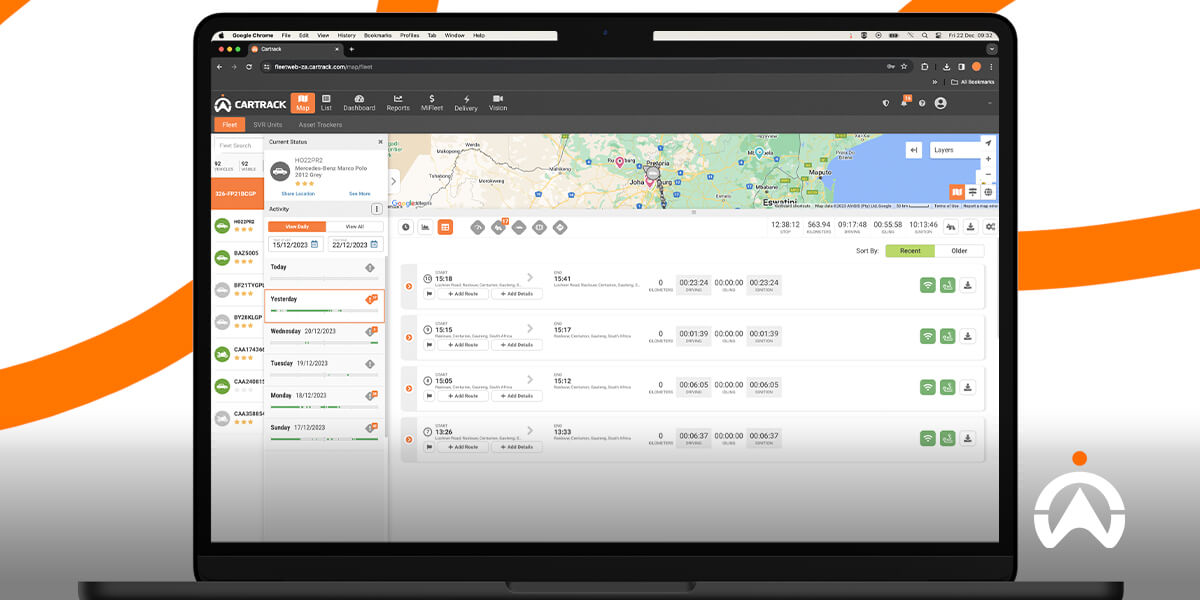

Elevate efficiency in your small or big business with Cartrack’s advanced fleet management software

Cartrack’s fleet management system gives you access to a wide range of software that caters to your fleet’s every need and helps you navigate the speed bumps you may face along the way. Here are 8 ways we’ll help you boost your small business:

  1. Live Vision AI cameras:Unlock real-time alerts on dangerous or distracted driving behaviour with Cartrack’s Live Vision AI cameras. Our cloud-connected video management software makes use of in-cabin cameras and AI analysis to give you access to real-time driver behaviour alerts. When dangerous driving behaviours such as speeding, yawning, cell phone use, and smoking are detected, in-cabin audible alerts immediately notify your drivers so they can correct their behaviour in real-time. You can also receive real-time alerts and access the footage via a livestream feed, ensuring that preventative maintenance is immediately implemented.
    ‍
  2. GPS Tracking:Accurately track your fleet vehicles’ location in real-time with Cartrack’s live GPS tracking. As a small business, you can use the data gathered from your GPS tracking data to monitor and improve overall fleet performance by pinpointing any inefficiencies. Real-time GPS tracking also gives you access to enhanced security and safety. Stolen vehicle recovery goes hand in hand with real-time GPS tracking, as the data that is recorded and monitored in real-time helps our highly skilled 23-hour recovery team track and recover your vehicle as quickly as possible.
    ‍
  3. Geofencing:Keep an eye on where your vehicles or equipment are being operated with Cartrack’s geofencing feature. This software allows you to set virtual boundaries around specific areas to monitor the movement of your drivers, vehicles, and equipment. Once a geofence has been set up, you can receive alerts the moment the vehicle enters or exits that specific area, which gives you real-time visibility into the activities of your fleet.
  4. Cargo Monitoring:Keep your fleet’s cargo safe with Cartrack’s cargo monitoring solutions. Working as a part of our AI-powered SmartCabin system, our cargo cameras help you gain unparalleled visibility of the cargo your vehicles are carrying. This software helps you easily monitor your cargo by live streaming up to four cameras and making it possible to download the recorded footage if potential cargo tampering is detected. Use this in conjunction with our specialised cargo door sensors, which send you real-time alerts the moment your cargo door is opened. If you are handling heavy cargo, you can make use of our tailgate sensors, which work to monitor the safety of heavy cargo by sending live alerts the moment your trailer’s tailgates are activated.
  5. Vehicle maintenance:Keep your fleet vehicles functioning at their optimum with Cartrack’s preventative vehicle maintenance. Powered by artificial intelligence and advanced analytics, our preventative maintenance software analyses vehicle performance and spots potential maintenance issues before they become dangerous and costly. Receive alerts about issues such as damaged brake pads, low water and oil levels, service interval reminders, and more so you can anticipate and avoid costly breakdowns, road accidents, and further damage to your vehicles and create effective maintenance plans.
  6. Fuel monitoring:Keep an eye on every litre of fuel with Cartrack’s fuel monitoring system, and make every cent count. Our fuel cost monitoring software works to review your fuel transactions, matches fuel receipts with a vehicle’s advanced telemetry, and provides you with real-time visibility into fuel usage. By making use of a fuel sensor that is installed in your vehicle’s tank, you can closely monitor how much fuel your vehicle is consuming. This makes the system essential to reducing fuel wastage, identifying fuel theft, and improving your fleet’s fuel efficiency.
    ‍
  7. Route optimisation:Determine the quickest and safest routes for your fleet’s drivers with Cartrack’s route optimisation. Accessible via our Delivery app, this feature gives you access to real-time alerts of route deviations and delays, which helps you ensure fast delivery turnaround times and boost customer service. You can also conveniently view driver statuses, which allows you to quickly assign tasks to your nearest available driver.
    ‍
  8. MiFleet:Know the exact running cost of your fleet with Cartrack’s MiFleet software. Whether you have one or one hundred vehicles, you need to effectively manage your fleet-related finances, and our software works as your assistant. MiFleet is a vehicle cost management software that helps fleet managers keep track of their fleet expenses, ranging from taxes and vehicle permits to finance and fuel costs. By giving you in-depth insight into your fleet’s expenses, you can unlock greater fuel and cost savings and reduce admin time and fees.
    ‍

Make big moves in your small business with Cartrack’s solutions

Truth is, small businesses need to think big if they want to remain relevant and succeed. No matter the size of your business, let’s get the best out of your fleet and take your company to the next level.

Chat with us here today.

Fleet Management Best Practices – Unlock The Roadmap To Revenue

Fleet managers have a finger in every pie. That isn’t a bad thing. It’s how they ensure business success. 

They are often responsible for empowering their fleet and figuring out how to implement the best practices for overall fleet efficiency.

From customer and client services to ensuring timeous fleet activity, cutting costs, and improving efficiency, to seeing that drivers and fleet vehicles are in tip-top shape.

Let’s unpack the key to fleet management best practices.

In this article, you will:

  • Understand the different fleet management practices
  • Learn how to increase your revenue with better fleet management practices
  • Discover how to build a fleet management plan to combat your business challenges
  • Know how Cartrack’s fleet management software helps businesses accelerate revenue

What is fleet management?

Fleet management is all about overseeing the operation of various types of vehicles e.g. buses, cars, trucks and even other assets used for business purposes. It’s not just about keeping them fueled and maintained; it’s about building a system that ensures efficiency, safety, and cost-effectiveness.

What are the priorities of fleet management?

Fleet management priorities can vary depending on the specific industry, company size, and individual fleet goals. However, some key priorities are generally applicable across most contexts:

  • Safety and compliance
  • Efficiency and cost management
  • Driver management and engagement
  • Sustainability and environmental awareness
  • Technology integration
    ‍

These are the general properties that fleet managers concern themselves with daily. By developing a comprehensive and effective fleet management strategy, fleet managers can improve vehicle and driver safety, maximise efficiency and increase cost savings.

Let’s take a look at the common fleet management practices involved in a fleet system.

Common fleet management practices

  1. Vehicle acquisition
    Vehicle acquisition is the crucial process of adding new vehicles to the fleet. It’s more than just buying cars; it’s about strategically selecting the right vehicles, at the right time, in a cost-effective way, that will reap the most rewards for your business.
    ‍
  2. Vehicle tracking
    This is the backbone of modern fleet management, providing real-time information on the location, movement, and performance of company vehicles. It’s like having a continuous digital eye on your entire fleet as you get data-driven insights.
    ‍
  3. Route management and dispatch
    Fleet managers are responsible for the planning and coordination of their fleet, which involves assigning tasks, and planning the best routes for drivers based on real-time data, customer needs and driver availability.
    ‍
  4. Fuel management
    Fuel management in fleet management is all about squeezing the most miles from every drop, optimising fuel consumption, and saving costs. It’s not just about filling tanks; it’s a strategic approach to monitoring, analysing, and controlling fuel use across the fleet.
    ‍
  5. Monitoring driver behaviour and safety
    Keeping drivers safe and their behaviour responsible is paramount in fleet management. This involves actively monitoring and improving their actions on the road. Fleet managers prioritise driver safety to reduce accident rates and lower maintenance costs.
    ‍
  6. Scheduling fleet maintenance
    Keeping your fleet in tip-top shape is crucial for reliable operations, driver safety, and cost control. Fleet managers work to schedule maintenance and will accurately and efficiently ensure vehicles are serviced at the right time, preventing breakdowns and maximising their lifespan.
    ‍
  7. Vehicle rotation
    Rotating vehicles involves strategically swapping or reassigning vehicles within a fleet to optimise their use and lifespan. It’s not just about switching keys; it’s about maximising efficiency, minimising wear and tear, and ensuring the right vehicles are in the right hands.
    ‍
  8. Fleet economics
    Fleet economics delves into the financial aspects of managing a fleet of vehicles. It’s about understanding the costs involved, optimising resource allocation, and making informed decisions to maximise profitability and minimise expenses.
    ‍
  9. Safety and compliance management
    Safety and compliance are pillars of successful fleet management. It’s about more than just avoiding accidents and fines; it’s about creating a safety culture and ensuring every element of operations adheres to regulations.
    ‍
Common_fleet_management_practices

The purpose of fleet management

Fleet management is the smartest way that businesses with moving assets can improve their operations, from productivity, security, compliance, safety and reduced costs. Strategic fleet management has plenty of benefits that guarantee a well-oiled fleet operation.

Here are the top benefits of fleet management:

  • Improves driver and road safety
  • Optimises fleet operations (on-time deliveries, optimal routes, fast dispatch, etc.)
  • Helps reduce fleet costs while boosting profits
  • Enhances overall visibility into fleet activities
  • Generates important compliance data
  • Increases vehicle longevity
  • Improves fleet security by discouraging theft, fraud, and vandalism
  • Helps lower fleet emissions and fuel consumption
  • Enhances work experience for the fleet crew
  • Ultimately improves customer satisfaction
    ‍

Guide: how to increase revenue with these five fleet management best practices

With fleet management, it’s not only about acquiring more vehicles or getting more drivers. Every link in the chain is supposed to result in increased revenue for the company. This can only be achieved by implementing best practices for fleet management.

These five best practices for fleet management can help you increase your revenue:

1. Use fleet data management software

Fleet data management refers to the processes of using the powers of GPS, AI and other tech, to gather, organise, consolidate, analyse and report on the fleet operations in a business.

This is a strategic way of creating a system for fleet diagnosis which helps businesses to identify areas for improvement, optimise performance, and prevent problems.

There are a few strategies businesses can use to ensure they are on the right track:

  • Using data on vehicles to make better decisions
  • Leveraging driver logs
  • Upgrading your dispatching system
  • Prioritising maintenance
    ‍

2. Use fuel management solutions

Introducing fuel monitoring strategies and fuel cost management solutions is one of the smartest decisions fleet managers can make. Businesses are challenged by the rising fuel costs, as well as other pain points like fuel theft and fuel waste caused by poor route planning.

These best practices for fuel management will help businesses increase their revenue:

  • Monitoring fleet fuel trends
  • Improving driver behaviour
  • Stop fuel-card fraud and fuel theft using automated systems
  • Detect the impact of fuel increases on fleet fuel management

 3. Improve driver administration

Driver administration in fleet management involves managing your workforce who drive your wheels. It’s about ensuring your drivers are qualified, understand safe driving practices, can be productive and ultimately that they successfully drive your fleet.

These best practices for hiring and managing drivers will help businesses increase their revenue. Here are some best practices:

  • Select qualified and licensed drivers
  • Introduce training on safety and good driving practices
  • Implement performance management
  • Train drivers on fuel-saving driving practices

4. Develop a fleet maintenance strategy

‍The best way to stay on top of your fleet’s performance is to get ahead of your fleet maintenance strategy. Fleet managers can ensure their vehicle stays on the road longer and reduce the cost of upkeep, by using fleet maintenance. Whether the maintenance strategy is preventative or predictive, you get to decide the smartest strategy for your fleet

Here are the best approaches for fleet maintenance for businesses:

  • Avoid reactive fleet maintenance.
  • Opt for either a preventative maintenance strategy or a predictive maintenance plan
  • Use digital systems to streamline your process and keep accurate records of vehicle health
    ‍

5. Become customer-centric

Client satisfaction is the number one priority for your business to ensure and improve the revenue of your business. Focusing on customers leads to increased sales, and higher customer loyalty and will help you gain new customers. By running efficient operations, fleet managers and business owners, gain in every way possible.

Here are some best practices to boost customer satisfaction:

  • Route planning for deliveries to ensure that goods, equipment and services are timeously delivered to customers.
  • Improve communication with customers, if there are delays or changes in delivery dates, it is better to communicate this with customers.
  • Reduce the frequency of breakdowns, through maintenance plans and proper fuel management.
    ‍

Every business is unique and has its fleet challenges. A small business, for example, may have 5-10 vehicles, while a more established fleet company can have over 50, and even 100 fleet vehicles to manage. Businesses in different industries also have unique challenges, relating to their fleet operation.

Let’s have a look at this guide for different businesses.
‍

how_to_increase_revenue_with_these_five_fleet_management_best_practices

Guide:  how to build a fleet management plan to combat your business challenges

A fleet management plan is valuable for companies in different industries, including companies in construction, oil and gas, cold chain supply, engineering, logistics and even finance or security services.

Here’s a quick guide on how to build a fleet management plan in three types of industries to combat various business challenges.

Construction

Construction businesses face unique challenges when it comes to managing their fleets. Beyond the usual concerns of cost, efficiency, and safety, specific factors in the construction environment add an extra layer of complexity. Here are some key challenges that a fleet management plan can help businesses in construction.

Common Fleet Challenges

  • Heavy wear and tear on specialised equipment
  • Project-based operations
  • Locating construction equipment
  • Driver management and safety
    ‍

Transportation

From trucking companies to ride-sharing platforms, all transportation businesses, face a unique set of challenges in managing their fleet. Challenges that are more prevalent in this industry. Here are some of the challenges that a fleet management plan can help a transportation business with.

Common Fleet Challenges

  • Rising fuel and maintenance costs
  • Minimising vehicle downtime
  • Keeping up with new legislation
  • Vehicle utilisation
    ‍

Food industry

Transporting temperature or time-sensitive goods is a challenging task for fleet management, but in the food industry, it’s not something that can be compromised. The biggest challenge for these businesses is that it is highly customer/business partner-centric, and share similar pain points.

Common Fleet Challenges

  • Poor customer service
  • Driver shortage
  • Late/failed deliveries
  • Reducing theft or product damage
    ‍

With each of these challenges affecting different industries, introducing a general fleet management plan will not automatically improve some business operations. Your fleet management plan should be strategic and incorporate best practices for efficiency and to ensure revenue.

4 ways Cartrack paves the way to fleet management best practices

When you are ready to transform your fleet management practices, from common to best practices, then Cartrack’s advanced software offers the smartest solutions.

Here are four ways Cartrack’s Fleet Management Software can help your business establish best practices for increased revenue.

 1. Data accuracy and reliability

As a fleet manager, you may often encounter challenges in maintaining accurate and up-to-date information about the location of fleet vehicles, assets, or cargo.

With telematics installation in your fleet vehicles, trailers and assets,  fleet managers can ensure the reliability of the data and monitor their vehicle and equipment activities. Fleet managers gain a comprehensive view of their fleet performance and operation with Cartrack’s Fleet Pages. Fleet managers can optimise fleet routes, monitor their fleet vehicle usage, and access vehicle and driver reports.  With the addition of sensors, fleet managers can also ensure the safe transportation of their cargo.

Our advanced Internet of Things (IoT) tech goes beyond vehicle tracking and provides accurate data about your fleet that can be used to improve the overall efficiency and performance of your business operations.

2. Fuel monitoring and management

Fuel is one of the largest expenses in a fleet business, and with fuel costs being so volatile, managers need to conserve and monitor every drop in their fleet. The lack of fuel efficiency can impact the productivity and profits of a business.

With Cartrack’s fuel sensors, you can accurately measure the amount of fuel in your vehicle tank. These sensors are installed in a vehicle, such as a truck, bus or private car, as well as ships and also stationary equipment like generators. With these sensors, fleet managers can know about any increases or decreases in fuel levels, and accurately monitor any refills or fuel waste and loss events. With additional software integration like MiFleet, fleet managers can also have the system automatically review all their fuel transactions, match fuel receipts with vehicle telemetry data and receive alerts on any abnormal fuel costs. This helps them detect any fuel theft or fraud. Our fuel monitoring and management software is one of the most advanced ways to monitor your fleet’s overall fuel consumption and compile reports on fuel expenditure, levies and taxes.

3. Fleet maintenance solutions

Often vehicle and equipment breakdowns directly affect business revenues. If your fleet is not operating or your equipment is non-operational, your business loses money on downtime.

One of the most effective ways to avoid vehicle downtime is through fleet maintenance. Businesses can avoid reactive maintenance on their fleet by introducing a predictive or preventative fleet maintenance solution. This helps businesses stay ahead of any vehicle breakdown.

Cartrack’s fleet management system is a quick and accessible way to schedule maintenance for your fleet. On this all-in-one platform fleet managers can receive notifications about their vehicles’ condition. For example, they can receive information about engine faults and various reminders about when to get an oil change or change tyres based on the vehicle mileage. This makes it easy for fleet managers to schedule vehicle maintenance and set up any other reminders/alerts for vehicle services and repairs.

4. Driver performance monitoring

Whether it’s recklessness, negligence or apathy, your drivers’ behaviour on the road could cost your business more than just a few speeding fines.

Cartrack’s driver safety and SmartCabin camera technology help managers monitor driver performance using various in-built software.  SmartCabin uses live streaming, AI cameras and real-time audible alerts to record and discourage dangerous activity while drivers are en route. These cameras can detect events such as distracted/fatigued driving and phone use while driving. It also gives front collision warnings to help drivers quickly change their actions and prevent accidents.

By monitoring driver performance behind the wheel, fleet managers can cut inefficient practices that hurt your business’s revenue. With Cartrack’s IoT, managers can also access driver reports to discourage bad driving habits. Installing telematics solutions and smart AI-powered cameras can help fleet managers identify poor driving practices, high-risk driving behaviour and various safety violations. Fleet managers can use this information to get proactive about driver, cargo and fleet safety, creating a safer driving culture.

Unlock the roadmap to revenue today

Secure your business’s bottom line, quarter after quarter by implementing these essential guides for fleet management best practices.

With Cartrack’s fleet management solutions, you can turn this roadmap into a sure way to unlock sustained financial growth as a fleet manager.

Contact us today and let us help you go from common practices to the best.

Truck Accidents: How To Shield Your Drivers And Protect Your Fleet

With the 10th largest global road network as well as booming transport and logistics industries, South Africa is, unfortunately, a potential hotbed for road accidents. Truck drivers transport cargo on SA roads daily, making truck accidents a real risk fleet managers must mitigate.

But don’t hyperventilate yet; there are smart solutions and software that can help you optimise your fleet operations and increase your fleet safety.

Ready to start dramatically decreasing truck accidents in your business?

Let’s dive straight in.

In this article, you will:

  • Learn more about the causes of truck accidents
  • Determine if and how fleet accidents can be prevented
  • Wise-up on top tips to avoid and minimise truck accidents
  • Understand the importance of driver wellness
  • Get insights on driver safety that help reduce the risk of trucking accidents
  • Discover how Cartrack can help you dramatically reduce truck accidents

Why it’s essential to protect your fleet from truck accidents

Automotive road accidents have disastrous consequences with potential injuries and even fatalities.

However, there are other influential factors from a fleet management perspective. The fewer truck accidents, the more improved and consistent your fleet’s performance and confidence will be. You’ll also see a notable reduction in maintenance costs as fewer vehicles need to be repaired or replaced and a visible increase in ROI.

Why_it’s_essential_to_protect_your_fleet_from_truck_accidents

The top trending causes of commercial vehicle accidents

  • Speed: According to the United States Department of Transportation’s National Highway Traffic Safety Administration, speed contributes to a concerning one out of three fatal truck accidents in the US. While this may be related to the systematically rising speed limits in several states, speeding in South Africa is a big concern even without speed limit increases.
    ‍
  • Distracted driving: Another trending cause of commercial vehicle accidents is distracted driving, and the statistics in South Africa are concerning. According to the International Transport Forum’s Road Safety Annual Report, South Africa has one of the highest road accident rates in the world, and around 25% of those crashes are caused by using mobile phones while driving — a classic example of distracted driving.
    ‍
  • Driver fatigue: Traveling hundreds of kilometres doing a monotonous task like long-distance driving takes its toll on the body and mind and can cause serious deterioration in the required alertness and concentration. According to Arrive Alive, 41% of road accidents are fatigue-related, while 39% of problems truck drivers experience are fatigue-related.

Discover the most pressing FAQs about truck accidents

1. How do truckers protect themselves?

Prevention is most definitely better than cure, and in long-distance truck driving, it’s the best way to avoid potentially devastating accidents that may cost truckers and other motorists their lives.

There’s also the issue in South Africa of trucks being prime targets for commercial vehicle hijackings precisely because of the commodities they’re transporting. In these cases, the following precautions can help keep truckers, vehicles and cargo safe on the road:

  • Sticking to pre-planned routes,
  • Staying in regular contact with your dispatcher,
  • Keeping the vehicle locked at all times,
  • Only parking in well-lit areas,
  • Avoiding picking up hitchhikers, and
  • Only stopping at official truck stops

2. How can truck accidents be prevented?

Like all fleet vehicle accidents, truck accidents cannot be a hundred per cent prevented. To ensure a fleet is prepared for any situation on the road, fleet managers can implement various strategies and technological solutions to minimise the risk of accidents and increase efficiency.

Cartrack’s fleet management solutions provide a range of options to help increase driver safety and simplify the tracking of driver behaviour and risky driving with automated fleet admin.

3. How do I protect myself from other drivers?

If there’s one thing professional truck and other fleet drivers are well aware of, it’s that you can never presume the behaviour of another driver while on the road. So, it’s crucial to practise defensive driving techniques like:

  • Anticipating and predicting the behaviour of other motorists, whether they’re pedestrians, drivers, or cyclists.
  • Obeying traffic rules with no exceptions
  • Practising caution
  • Maintaining a safe following distance. Training your drivers to have a defensive driving mindset is crucial to setting a gold standard for safety and reducing the risk of accidents and injury on the road

Lower the risk of accident with these 4 top tips

Monitor and reward safe driving

Using a reward system or positive reinforcement strategy is a viable way to improve road behaviour and compliance linked to driver safety and reduced accident risk. Driver reward system efficiency is well-researched, and by getting to know your drivers’ behaviour more intimately with a driver monitoring system, you can create a solid base for relevant assessments that offer rewards your fleet drivers will value, fostering motivation and team workplace compliance.

The link between motivation andcompliance is essential to ensure safety and reduce truck accidents. Keeping tabs on driver behaviour with telematics technology helps keep your fleet safe and motivated.

Use advanced tech to your advantage

The good old dashcam can help you identify key causes of trucking accidents, road conditions, traffic issues, and driver behaviour. However, even more advanced cameras and SaaS-based technology are available to optimise fleet driver protection and reduce truck accident risks.

  1. A fleet management performance tracking system uses telemetry data to track different components of a fleet’s performance, including trip reports, risky driver behaviour like excessive braking and speeding, and whether drivers stick to their allocated route to help fleet managers effectively pinpoint areas of concern for effective training and improved driver safety.
    ‍
  2. With smart cameras, live stream technology, and face recognition, you’ll always know who’s in your driver’s seat. So, if there are incidents on the road with our drivers, you’ll have the video footage to help you settle any disputes and insurance claims.
    ‍
  3. If you don’t want your fleet vehicle to move, technology allows you to disable it remotely, significantly contributing to roadside safety for your fleet and other motorists. Controlling fleet vehicle movement can prevent accidents caused by driving under the influence, unauthorised vehicle usage, fatigued driving, and increased road safety.
    ‍
  4. Fleet management technology that allows streamlined reporting on driver behaviour is also a key contributor to tailor-made driver training by allowing fleet managers to pinpoint exactly where drivers are going wrong and focus on their improvement.

Encourage regular rest and breaks

Driving, especially long-distance driving, requires quick-wittedness and a healthy mindset. Studies have found that poor sleep quality negatively impactstruck drivers’ job performance, with a high percentage of drivers reporting sleepiness during the day. Software created to accurately monitor drivers’ working hours plays a vital role in making sure drivers are not overworked and minimising potential truck accidents caused by fatigue.

Getting a good night’s sleep and stopping regularly to freshen up on long routes makes the world’s difference in your truck drivers’ mental capabilities and drastically reduces the risk of having a truck accident.

Prioritise fleet vehicle preventative maintenance

Preventative maintenance has so many advantages that it’s difficult to imagine effective fleet management operations without it. From increasing fuel efficiency to saving on costly vehicle breakdowns, preventative maintenance also has a notable effect on reducing truck accidents.

By ensuring fleet vehicles are in peak working condition, you’re taking an essential precaution to protect your fleet and other drivers on the road against preventable accidents. A fleet should operate like a well-oiled machine, and it all starts with the health of your vehicles’ gearboxes, brakes, tyres, and lights.

Conduct regular driver training

With the right fleet management technology, you can monitor drivers closely and create a custom-made training programme vital to address your fleet’s flagged behaviours. Overall, it’s important to instil a defensive driving mindset, which creates a solid platform for responsible driving habits. Consider the following defensive driving tips:

  • Always be prepared for an emergency
  • Watch out for those blind spots
  • Keep enough following space
  • Communicate with other drivers
  • Make slowing down the default
Encourage_regular_rest_and_breaks

How Cartrack’s advanced software can help keep your drivers safe

With Cartrack, we design our products with your fleet’s safety in mind. By implementing advanced telematics-based fleet management and camera-based technology, you can help prevent truck accidents and optimise your business’s safety with the following state-of-the-art tech:

  1. LiveVision cameras for increased driver safetyHave 24/7, real-time access to driver activity in fleet vehicles with a flexible, user-friendly vehicle video system. This live-streaming system allows the improvement of driver safety, reduces driver liability by pinpointing and addressing unproductive behaviour, assists with insurance claims, and ultimately keeps drivers safe and compliant.
    ‍
  2. AI camera technology to address distracted driver behaviourEnsure increased driver awareness and concentration with advanced in-cabin AI technology that detects distracted driving behaviour. By sending audible, real-time alerts to drivers for behaviours like yawning, smoking, phone use and more, so your drivers can rectify mistakes in real time to prevent accidents and boost overall fleet safety.
    ‍
  3. Driver behaviour reports for effective, personalised driver trainingIdentify risky driver behaviour like speeding, harsh braking, cornering and more, and use these detailed driver behaviour reports to train drivers on where improvements need to be made, allowing you to instil a safer driving culture and boost fleet safety in your business.
    ‍
  4. Driver ID tags so you’re sure the right person is behind the wheelBeing able to choose who can and cannot start your fleet vehicles helps put you in control of your fleet’s safety. You can stop unauthorised vehicle usage by giving each driver a unique driver tag, which they need to tap against a sensor to start their fleet vehicle, helping you increase driver safety and reduce the risk of accidents.

Discover how Cartrack empowers Diraro Group to minimise truck accidents

At Cartrack, we aim to take the guesswork out of long-distance commercial trip safety and help you reduce fleet incident rates.

Here’s how we helped Diraro Group reduce fleet accident risks and increase driver security:


Get Cartrack and boost truck driver safety in your business

Contact us today to discover how Cartrack puts you in control of your fleet’s safety.

Buying a Car – Know the Worst Car Buying Mistakes

Buying a car comes with extreme highs and lows. On the one hand, you have the freedom to travel wherever your heart desires, and everyday trips to work are now a breeze, but on the other hand, you now have to navigate vehicle maintenance, petrol, insurance, and monthly car payments for your new set of wheels.

Before coughing up and driving off, consider going through these car-buying tips and insights to avoid making car-buying mistakes that could cost you thousands.

Let’s get straight into it.

In this article, you will:

  • Learn what car-buying mistakes to steer clear of
  • Explore the basics of buying a car
  • Weigh the pros and cons of buying a new or used car
  • Discover the benefits of installing a vehicle tracking device
  • Understand why Cartrack is the perfect vehicle tracking company for your new car

Thinking about those first or next set of wheels?

Found yourself thinking about buying your next or first car lately? Before you embark on test drives and dealership negotiations, buckle up and equip yourself with some essential knowledge.

This crash course on car buying will navigate you through the twists and turns of getting the perfect buy without experiencing any bumps on the road.

The worst car-buying mistakes

Steering clear of common car-buying blunders is crucial for a smooth purchase experience. To avoid getting lost in a maze of bad decisions, here are the top five mistakes to avoid:

  1. Focusing only on monthly payments
    ‍
    When looking at your budget to assess if you can afford to buy a new car, don’t just concentrate solely on how much you will pay each month. Negotiating the overall vehicle price and financing terms separately is key to avoiding a higher overall cost.
    ‍
  2. Letting emotions drive decisions
    ‍
    ‍
    Falling in love with a particular model might lead to overpaying. It’s crucial to stay practical, do research, compare models, and ask yourself if the vehicle matches what you need and what you can afford.
    ‍
  3. ‍Skipping the test drive
    ‍
    Don’t judge a book by its cover, or, in this case, a vehicle by its design. Get in the driver’s seat and see what else the vehicle has to offer. The test drive is vital to ensure the chosen vehicle meets expectations and to prevent any surprises post-purchase.
    ‍
  4. ‍Overlooking used car inspections
    ‍
    When buying a used car, don’t always take the dealer’s word as fact. Get a trusted mechanic to further inspect the used vehicle. It is important to catch potential issues and avoid unexpected expenses.
    ‍
    ‍
  5. ‍Lack of research
    ‍

    Not visiting and comparing other dealerships or delving enough into the vehicle itself, like the pricing and financing options, can all lead to overpaying and making uninformed decisions.
    ‍

Now that you know what not to do when getting a car, let’s rewind to some car-buying basics and teach you all you need to get your new car off the lot and into your garage.
‍

‍Buying a car: 101‍

Acquiring a car is a decision one should take seriously, some take months contemplating the make, model, year, diesel or petrol and so much more. Before deciding on the popular brand out right now, consider asking yourself these questions:

‍Buying_a_car_101

When is the best time to buy a car?

The answer to this might vary depending on where you are in the world. In South Africa, there are various trends that car buyers follow to find the right vehicle at the right price, like sales promotions, new model launches, and holiday trends.

Motorists often follow the seasonal sales at the end of the year. Between October and December. Many dealerships push to meet annual sales targets during this period, offering discounts and promotions on both new and used cars.

Similar to seasonal clothing sales, when a car manufacturer introduces a new model, dealerships also often slash prices on older models to make space for the latest release. This allows you to enjoy reduced prices, just like snagging discounts during a fashion sale.

If you can’t afford to wait months for the prices to cheapen up, you can visit the dealerships midweek on a Monday or Tuesday. Most dealerships are not as busy during the week, so you can take advantage of the low sales and strike up a deal.
‍

What are your needs?

Finding the perfect car involves thoughtful consideration of various factors like financial planning, lifestyle preferences, and car features to ensure your choice aligns seamlessly with your priorities and, most importantly, your wallet.

  • Financial planning: Think about what you can comfortably afford, not just for the car but also for insurance, fuel, and upkeep. Set a budget limit and stick to it.
    ‍
  • Lifestyle and requirements: Are you a city driver or someone who loves weekend trips? Consider what you need for daily life and plans, like space for the family or golf clubs, or maybe both.
    ‍
  • Car features: First, focus on important things like safety and reliability. Then, think about extra stuff like fancy tech or comfort. Usually, the more extras you want, the more it’ll cost, right? But if you want extra features from an affordable car, then buying a used vehicle with all the extras already included at a low price would be a big benefit.
    ‍‍‍ 

What are the first steps of buying a vehicle?

When it comes to choosing your ideal vehicle, it’s all about informed decisions and hands-on experiences. Here’s how to navigate the process seamlessly:

  • Do the research: Look up trusted brands online, learn as much as you can about the different types of vehicles, and ask around amongst your peers about their opinions.
    ‍
  • Explore: After reading articles and brand pages, your work is not yet finished. Visit dealerships, check online listings, and consider used cars for potentially better deals. If you’ve made your choice and have a specific car in mind, set up a test drive and experience driving the vehicle.
    ‍
  • Get a quote: If you think you’ve found the one, get a quote for the car from different dealerships and online car-selling platforms to compare prices and finance options.
    ‍

Did you read the fine print?

It is time to “cross the ‘t’s and dot the ’i’s.” When it comes to paperwork, you must understand the small details. Take a closer look at the following:
‍

  • Insurance: Once your vehicle is on the road, its value decreases, and various issues like windscreen damage or hijacking can happen. Having insurance is crucial for protection. Select the coverage that fits your requirements and pocket.
  • Maintenance package: Think about a maintenance plan that suits your vehicle’s requirements and usage. Invest in an extended warranty or maintenance package to enhance your vehicle’s well-being, ensure its longevity, and possibly reduce future repair expenses.
    ‍

New or used?

Deciding between a new or used vehicle can be a tough call, with each option offering unique advantages and drawbacks. To help you navigate this important choice, let’s list out things to look out for each alluring option.

Pre-loved cars Brand new cars
Price Generally, it costs less upfront and might be negotiable. Higher initial cost, but the potential for incentives.
Depreciation Loses value more slowly over time. Rapid loss of value, especially in the first years.
Safety Depends on the condition of the vehicle and how old the vehicle is. Depends on the model, but should have the latest standard safety features, like emergency braking and lane departure warnings.
Insurance rates Often come with lower insurance premiums. Higher insurance costs due to the car’s new value, make, model and colour.
Variety More choices are available in the used vehicle market, from old to relatively new models. Have access to the latest models but sometimes new cars are not readily available, especially for high-end cars, so drivers have to be on a waiting list.
Condition May have some wear, tear and potential issues. New vehicles have no history of accidents or wear and tear. They also come with a maintenance warranty.
Customisation Modifications may already be done or available. Full range of customisation options from the start.
Warranty coverage Depending on the age, there might be limited or no warranty left. But some dealerships can provide a maintenance warranty at a cost. Typically comes with a comprehensive warranty of around 3-5 years or 100,000 km, whichever comes first.
Financing rates Higher interest rates for used car loans but lower total car costs. Lower interest rates for new car loans but higher overall vehicle cost.


How do you tell if a used car is a good buy?

If, after reviewing the list, you find yourself leaning more towards getting a pre-owned vehicle that matches your current needs and budget. It’s good to keep in mind that since these vehicles aren’t brand new and shiny, there are some additional precautions to consider to ensure the car you choose doesn’t have any hidden dents or extra expenses.

  1. Maintenance record
    ‍
    See if there’s a history of regular check-ups from a trusted garage. This tells you the car was looked after. If you can’t find these records or they’re not consistent, it might mean the car wasn’t well taken care of or has some hidden issues that might cost you in the future.
    ‍
  2. Hidden damagesDon’t just focus on the shiny leather and fresh car smell. Check the car thoroughly for dents, scratches, and rust, especially in hidden spots. When you take it for a spin, pay attention to any strange sounds or handling issues.Tip: If you see different paint colours or uneven body parts, it could mean the car had some fixes done. Ask the seller directly about any past accidents and get records if they have them.
    ‍
  3.  Inspect the interiorLook for signs of wear like worn-out seats, ripped upholstery, and electronics that don’t work right. Test everything – the air conditioning, radio, power windows – to make sure they’re in good shape. Keep an eye out for weird smells or stains, which might mean there’s been water damage or other problems.
    ‍
  4. Mileage‍Think about how much the car has been driven. Lots of miles don’t always mean it’s a bad car, but it might need more fixing. Compare it with the maintenance record to be sure.
    ‍
  5. VIN checkMake sure the car’s VIN (vehicle identification number) matches the documents. Use a VIN check service to find out if the car was in any accidents or had other issues. Always double-check that identification number if the VIN doesn’t match, it might mean the vehicle has been stolen.
    ‍
    You can learn a lot about a car’s history by checking out its previous owners and the reason why it was sold. An extra precaution to consider is to look up how many owners the car has had. The manual should provide this information, but the dealer should be able to provide it as well.
    ‍
How_do_you_tell_if_a_used_car_is_a_good_buy

Get a tracking device for your new vehicle‍

So you’ve chosen the vehicle and you’re happy with your purchase. The next mission to tackle is security; get yourself a vehicle tracking device.

These days vehicle theft is as common as vehicle buying. It is an unfortunate reality, and ensuring a car’s safety is a top priority for most motorists. In these cases, a vehicle tracking device is more than just an optional accessory — it’s a proactive measure to safeguard your valuable asset.

Most new cars at the dealership today are already fitted with a tracking unit to help you protect your investment. All you have to do is become an official client of that tracking company.

Benefits of a tracking device

Besides all the safety features a vehicle tracking unit comes with, it also provides a big advantage in terms of insurance. Insurance companies like vehicles with tracking units because they make it easier to recover stolen cars quickly. This not only lowers the risk for insurers but might also score you some discounts or lower premiums if you go for this extra security measure.

Let’s see other benefits that come with installing a vehicle tracking device.
‍

  1. Safety and security
    ‍
    – Decreased risk of theft: Without tracking, a stolen car is much harder to recover. With tracking devices installed, they can alert you in real time and assist police in locating your vehicle.- Emergency assistance: If you’re stranded or involved in an accident, you can use the provided mobile app to receive emergency assistance, or if the tracking unit has crash detection and you are involved in an accident, then the company will be notified of the event and send emergency assistance to your location.- Able to prove innocence: In the case of false accusations or hit-and-run incidents, proving your location and driving behaviour history through your GPS device can assist in validating your innocence.
    ‍
  2. Peace of mind and convenience
    ‍
    – Precise driver monitoring: Stay informed about your vehicle’s location and usage. For instance, when your teenager is behind the wheel, track their adherence to safe driving practices.- Reduced anxiety and stress: Eliminate uncertainty by always knowing your car’s whereabouts, even during nighttime journeys or on unfamiliar routes.
    ‍
  3. Financial aspects- Lower insurance premiums: As mentioned above, some insurance companies offer discounts for cars with tracking devices due to the lower risk of theft and fraudulent claims.
    ‍
    – Potential depreciation impact: Cars without tracking might be less desirable to future buyers, impacting resale value.- Costs associated with recovery: In case of theft, without tracking, recovery efforts can be time-consuming and very expensive, especially if the vehicle cannot be found and you have to potentially buy a new vehicle.
    ‍

Choose the right tracking unit for your new vehicle

Searching for a trusted GPS unit is as easy as opening your search engine and looking for the most reliable and proven vehicle tracking company. Among the many companies that present themselves, there is one that has one of South Africa’s highest stolen vehicle recovery rates — Cartrack.

Install a Cartrack tracking device on your new vehicle and enjoy these benefits:

To sweeten the deal, Cartrack offers quality value-added services:
‍

  • CarWatch: This acts as an early warning system that you can activate through our mobile app. Once activated, it alerts Cartrack if your parked vehicle is moved without your knowledge.
    ‍
  • Protector: Provides 24/7 professional roadside assistance when you press the button on the Cartrack app. This service covers battery jumpstarts, tyre changes and car towing. Plus Legal assistance and emergency or accident services if needed.

Give your new car that extra layer of security you can trust with Cartrack’s vehicle safety solutions. Join over 1,9 million other happy Cartrack customers worldwide and put your vehicle’s protection first.

Get your free installation today.